|
Gorrell Iron Works, Lakewood, Colorado
Photographed in August, 2012
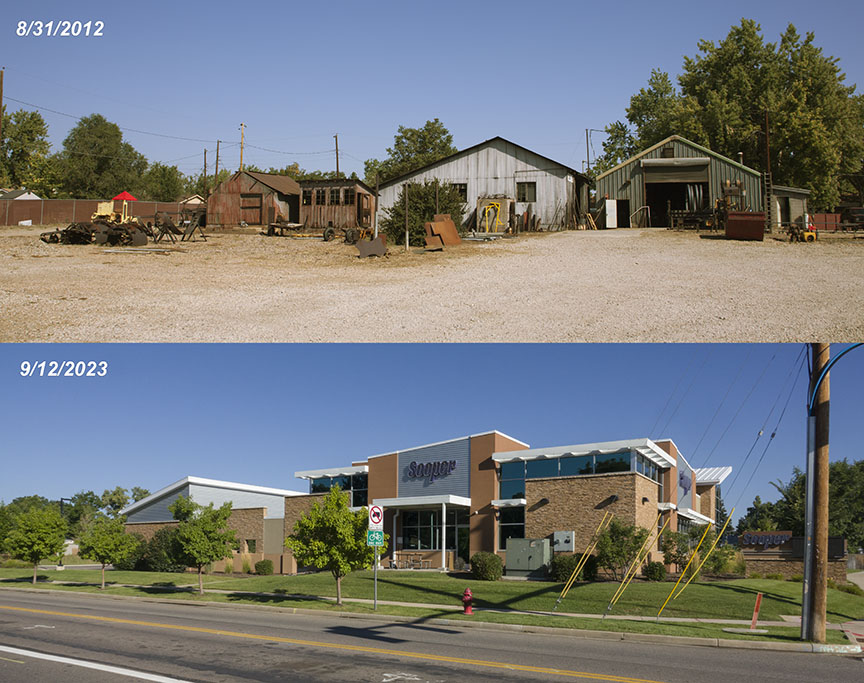
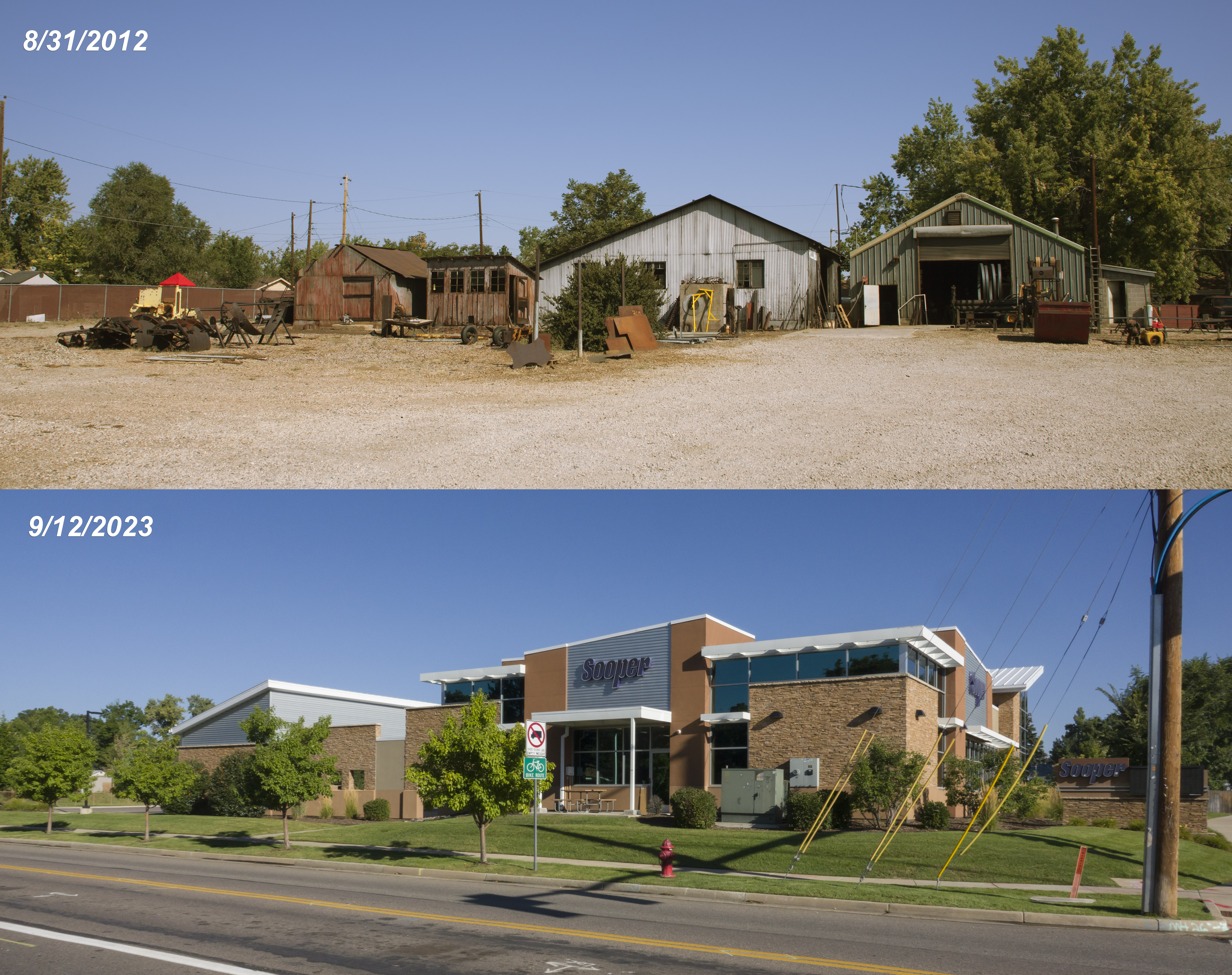
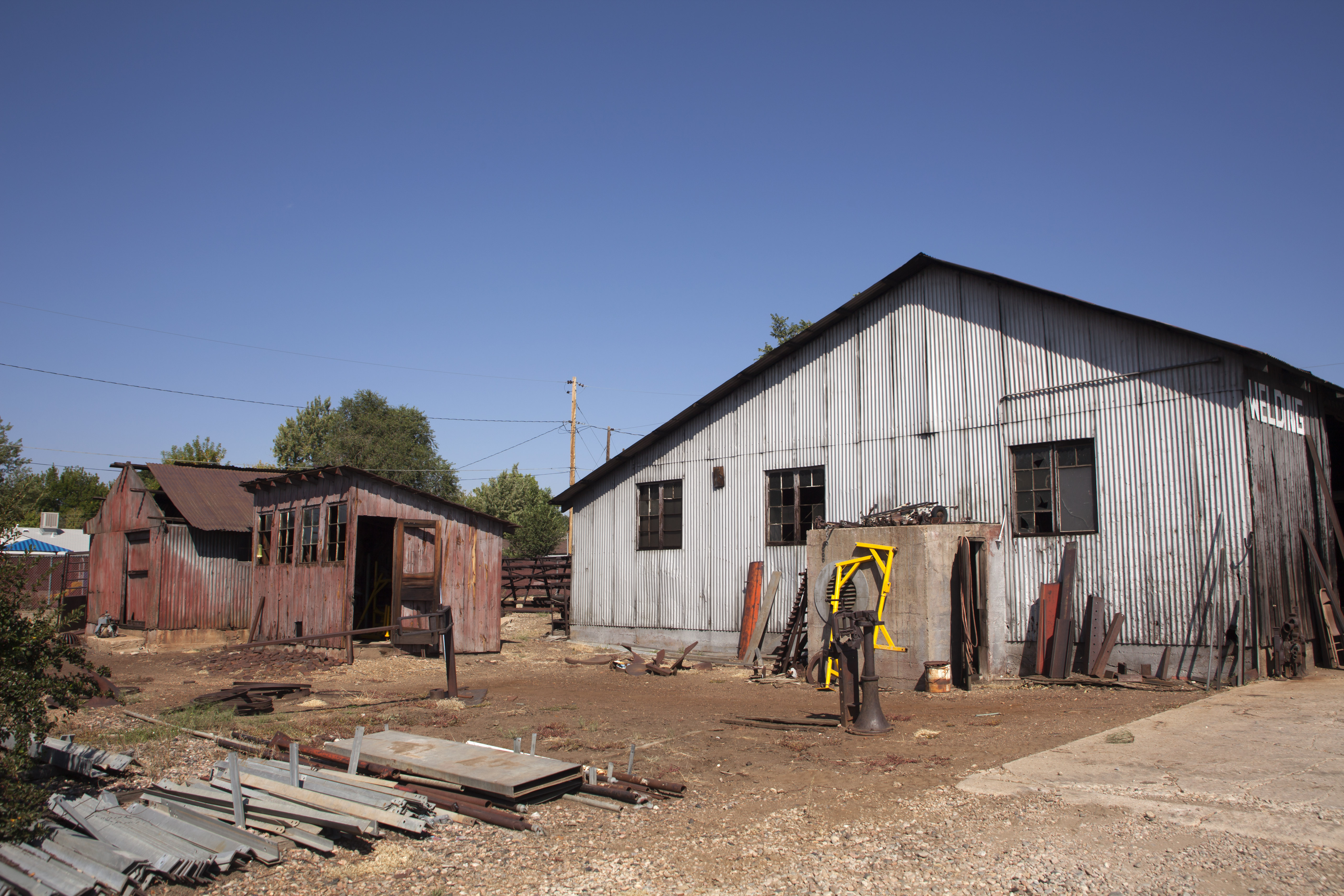
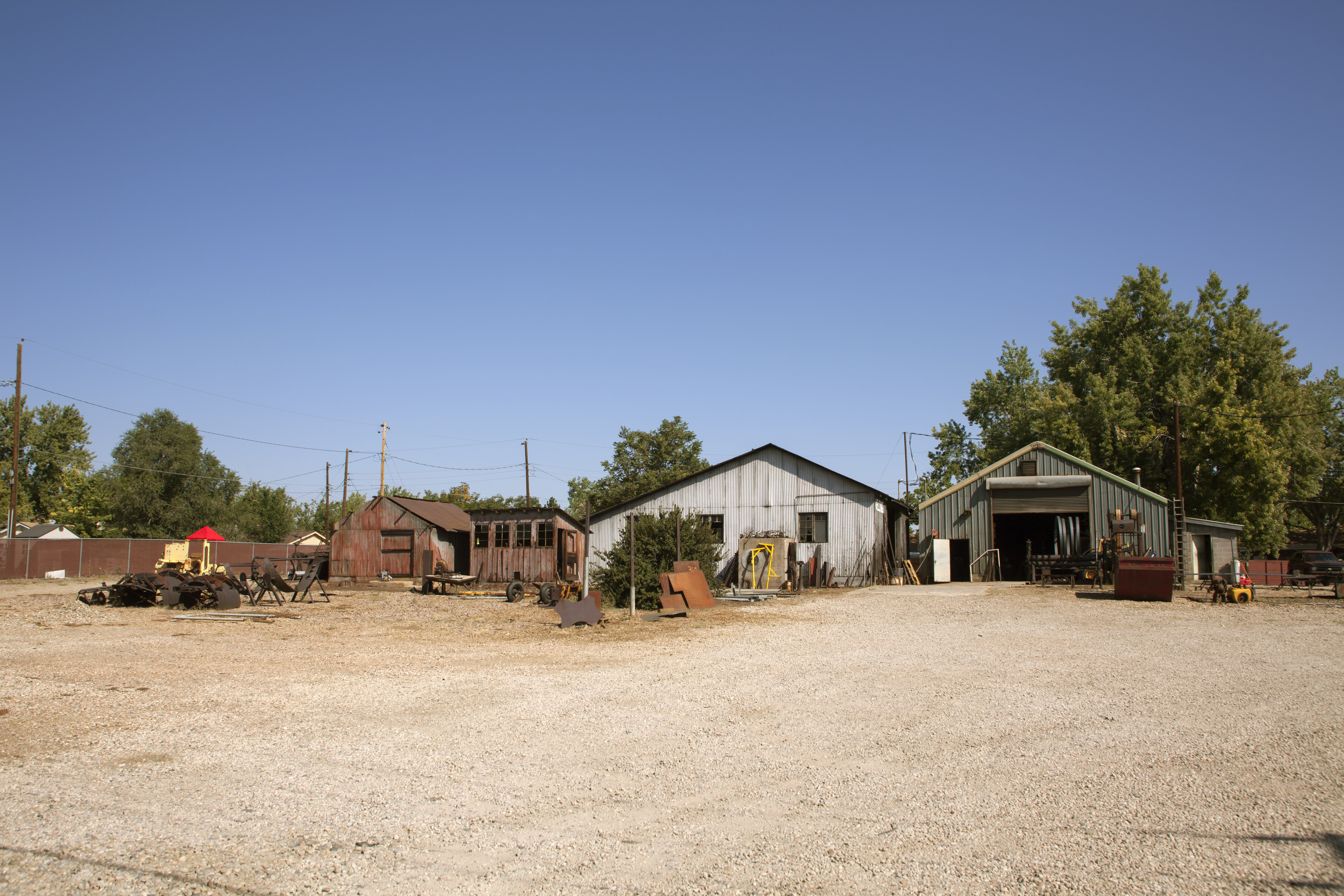
Once located at the intersection of South Wadsworth Boulevard and West Florida Avenue, the Gorrell Iron Works was opened in 1930 by Fred Gorrell, the son of a local dairy farmer, William T. Gorrell, whose farm was found just to the west. Fred opened his metals shop on property given him by his father. He also constructed a brick home with an underground garage - an uncommon architectural feature at the time, along with a corrigated metals building to house his iron repair business. There were also a number of other buildings, including sheds, chicken coop and always required outhouse. The old buildings were torn down in 2013 and replaced with a parking lot and an office building which housed a Sooper in 2023 and now houses a Climb Credit Union in 2026.
"During the pre-World War II days, blacksmith work in an agricultural area consisted largely of repair of farming equipment, trucks, graders and maintainers. Fire welding, now a near-lost art, was so precise that there was no sign indicating where metal was joined. Borax was used as flux. This work was important to the many farmers in the area whose plow shares were often in need of conditioning and repair.
When Gorrell died in 1978, he willed the iron works to a close friend and partner, Arnold Kerstiens, who had joined Gorrell in 1954 and continues to run the business.
Kerstiens is the son of Lawrence and Lilly Kerstiens who farmed along South Sheridan Boulevard and raised a family of six daughters and four sons. Kerstiens' iron works has kept the original forge where iron was worked by hand, as well as a diesel-fired heating oven where-iron was prepared for shaping and rolling." From Lakewood Colorado, An Illustrated Biography
Their work once consisted of manufacturing auger bits as well as repairing, renewing and or improving heavy equipment. The auger bits would range in size from typical widths, up to a huge nine foot diameter. Welding was done with electric welders, however in earlier days, carbide gas was used and stored in a special tanks designed for metal working. The iron works even made
new wheels for the old cannon on the grounds of the Colorado State Capitol in Denver.
The business was very unique for Colorado, routinely taking many jobs most other manufacturers would turn away. Throughout the decades, it seems that much of the old equipment and tools used in making and maintaining a menagerie of machines have stood in place and been used thousands of times since 1930. Once a living and working museum, it has now passed into history.
|
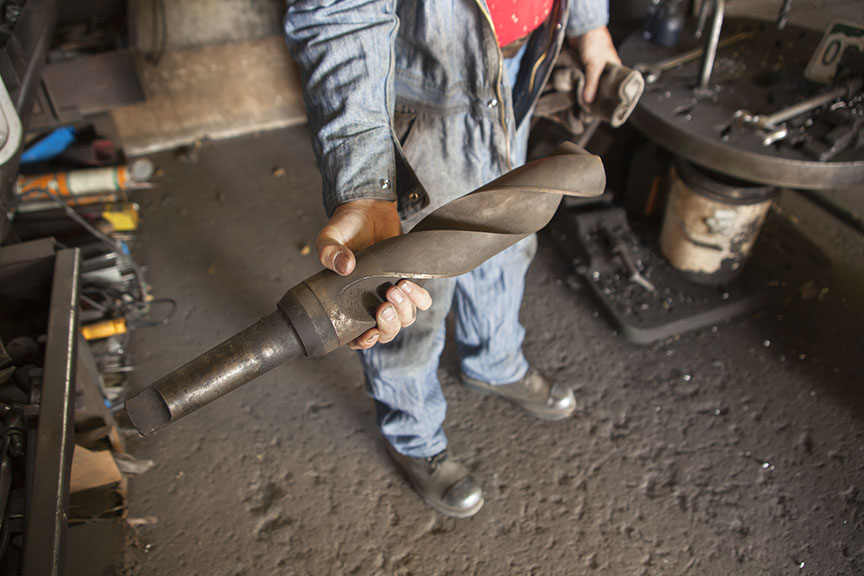
During a August 2012 visit, the steel-toed owner hefts a massive drill bit inside the Welding shop garage. |
 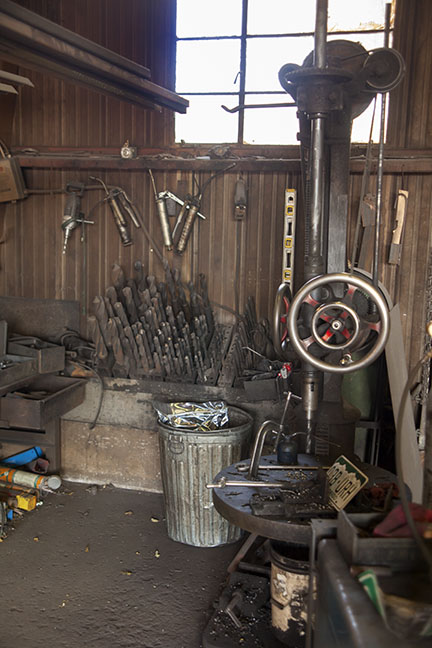
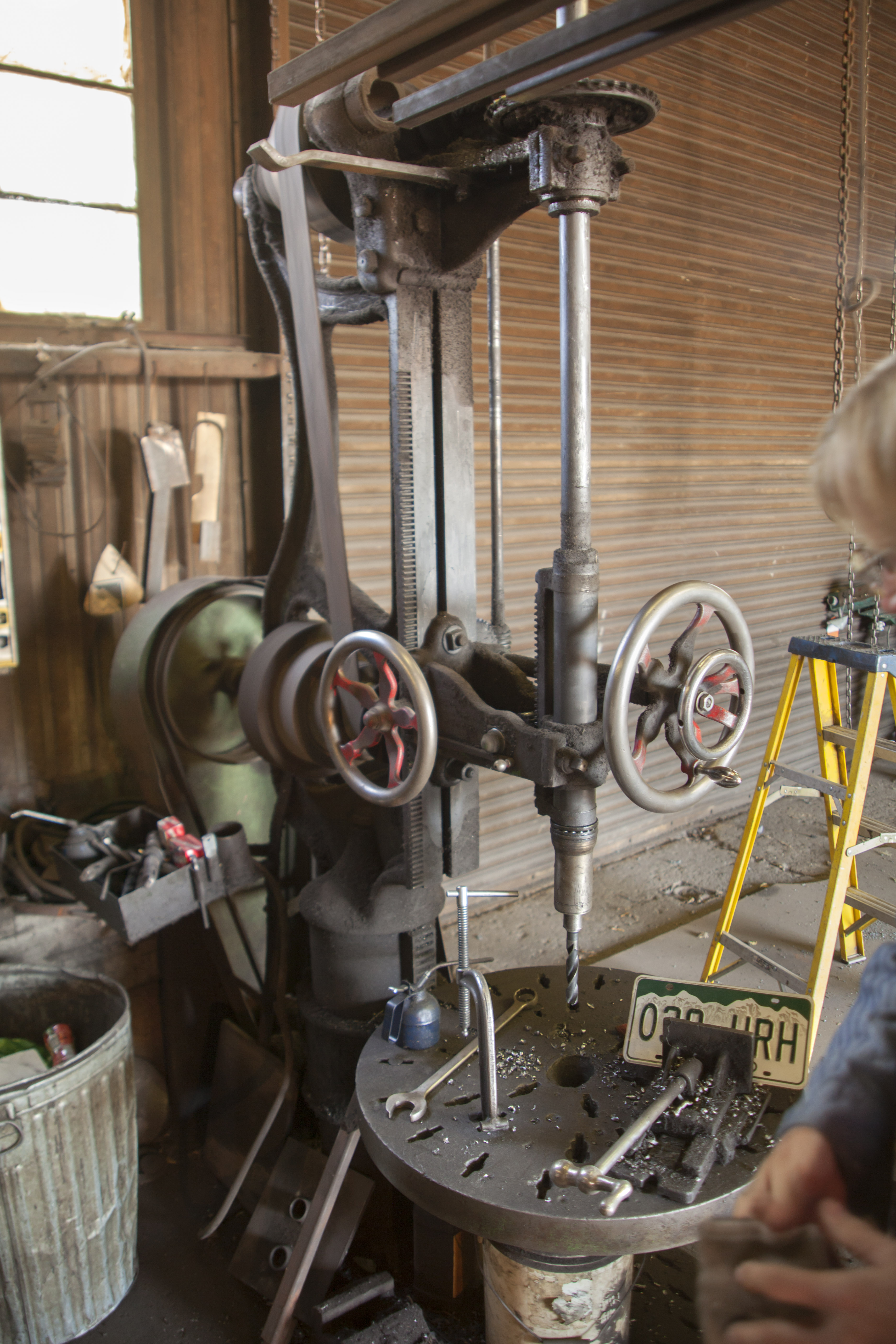
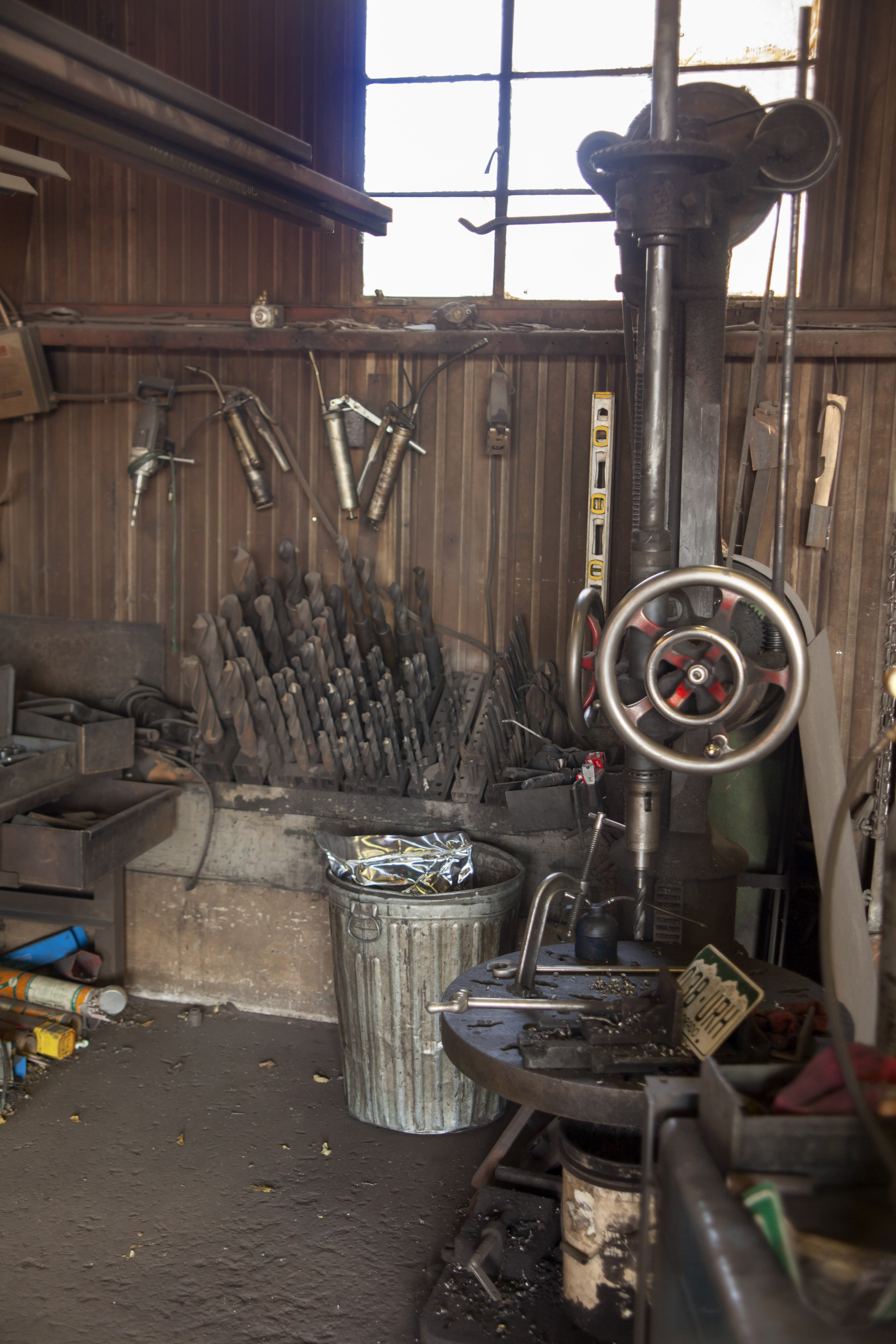
An oversized drill press with dozens of bits lined up along the back wall can handle typical sized bits drill bits as well as huge bits over three inches wide. Grease guns hang above the bits. |

Various stacks of metal lie on the ground and lean against the Welding building with the chicken coup and shed to the side. |
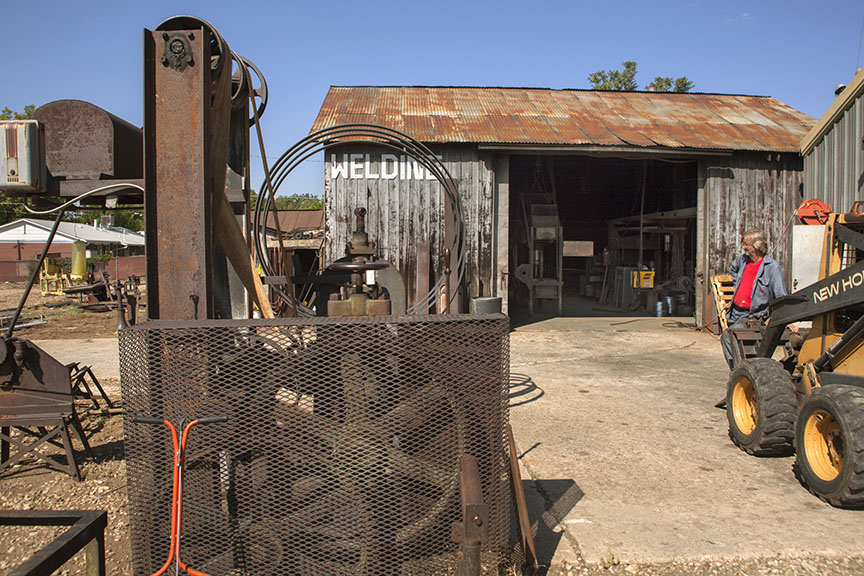
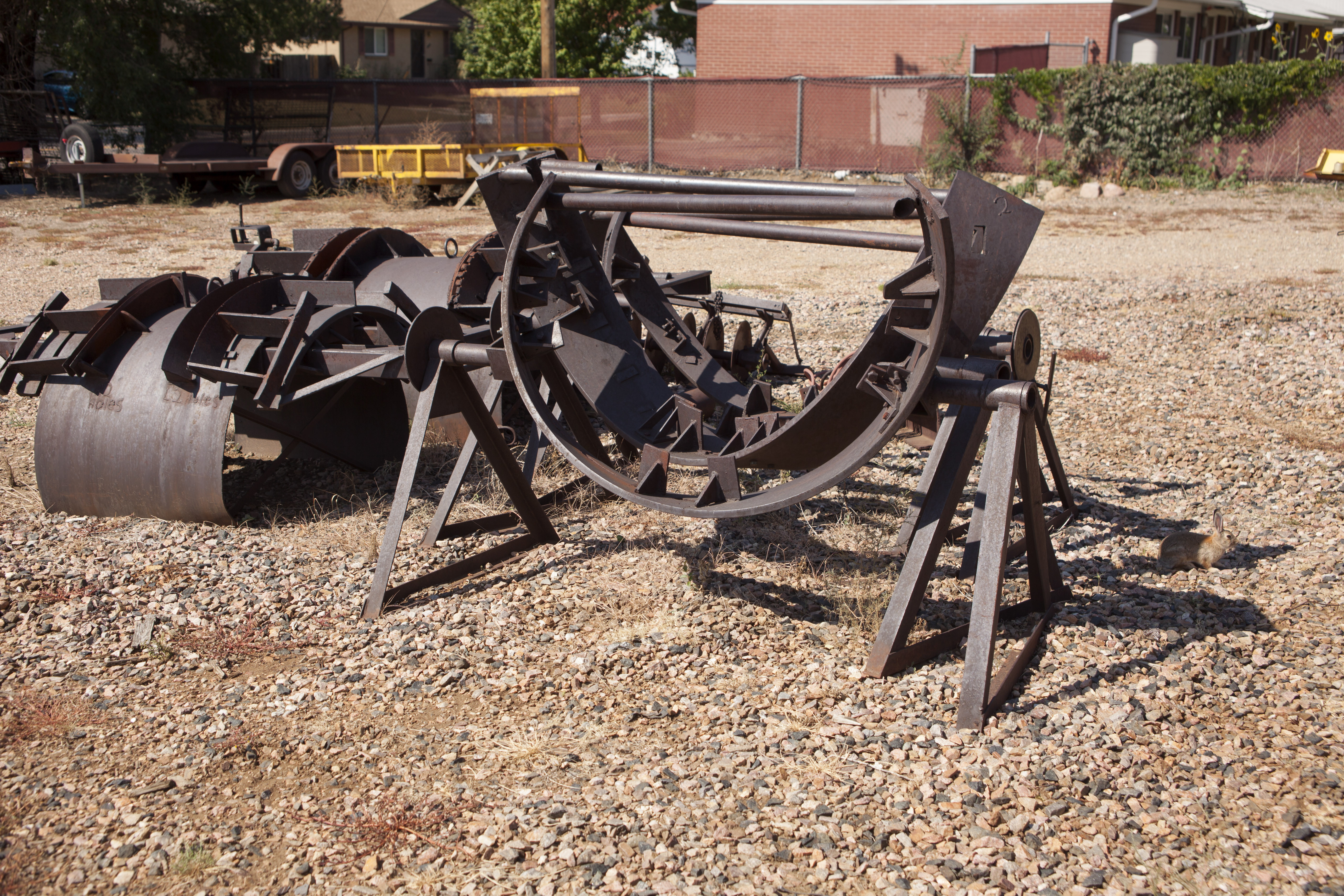
The 250 ton press can be seen in the Welding building and in front, an antique metal plate rolling and bending machine curls strips of sheet metal into giant round shapes. The belt driven machine has large gears protected by a wire mesh. The old machine originally came from the mining town of Blackhawk in the Colorado Front Range Rocky Mountains and was used to roll steel into round tanks. It can roll three-eighths inch steel plate eight feet long.
The 250 ton press can be seen in the Welding building in the background. |
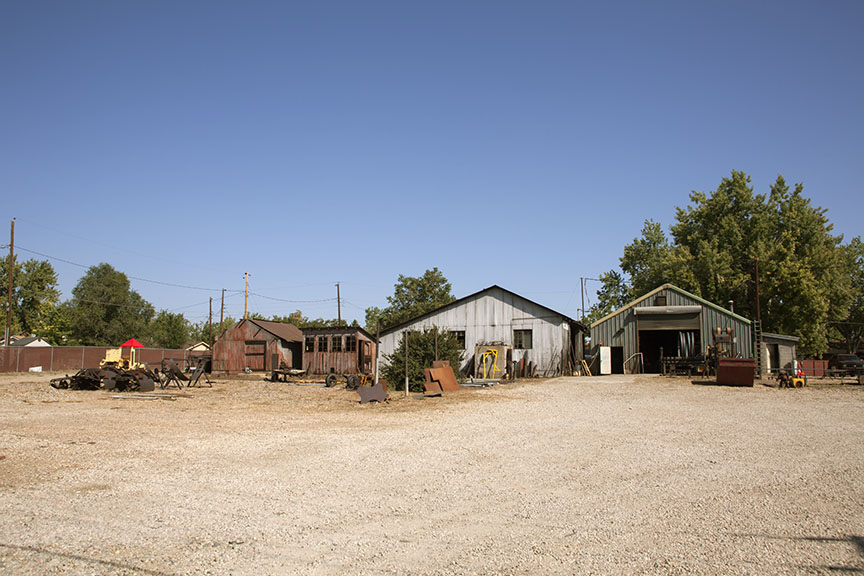
The 2012 general view of the Gorrell Iron Works before it was demolished for a parking lot and office building. |
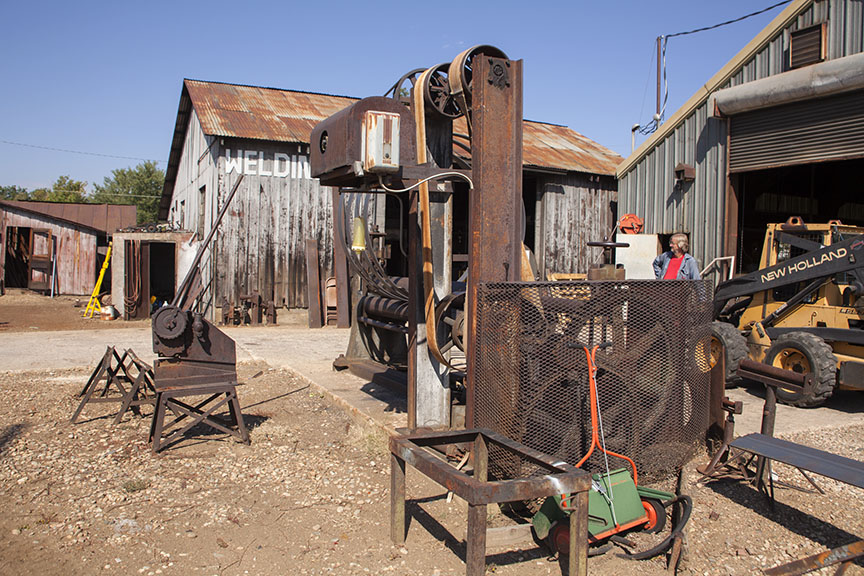
In front of the office and Welding building, an antique metal plate rolling and bending machine curls strips of sheet metal into giant round shapes. The belt driven machine has large gears protected by a wire mesh. The old machine originally came from the mining town of Blackhawk in the Colorado Front Range Rocky Mountains and was used to roll steel into round tanks. It can roll three-eighths inch steel plate eight feet long. |
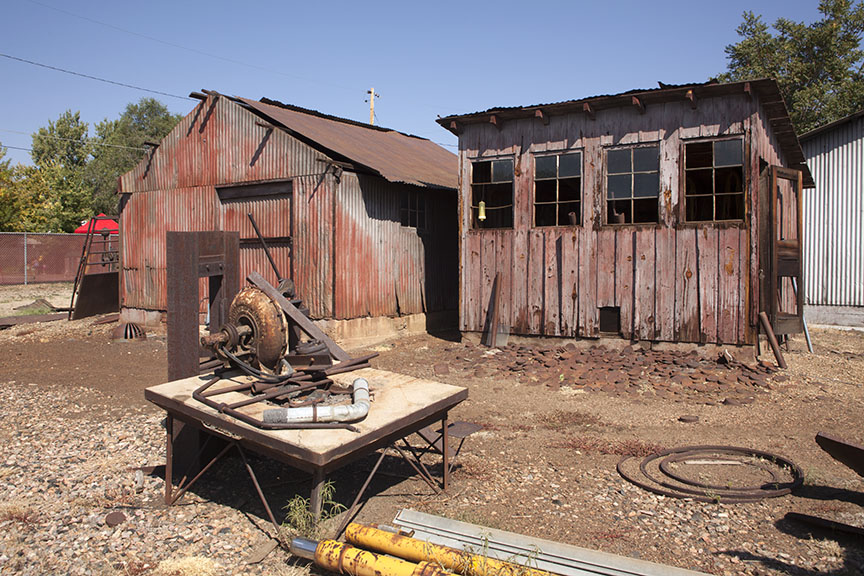
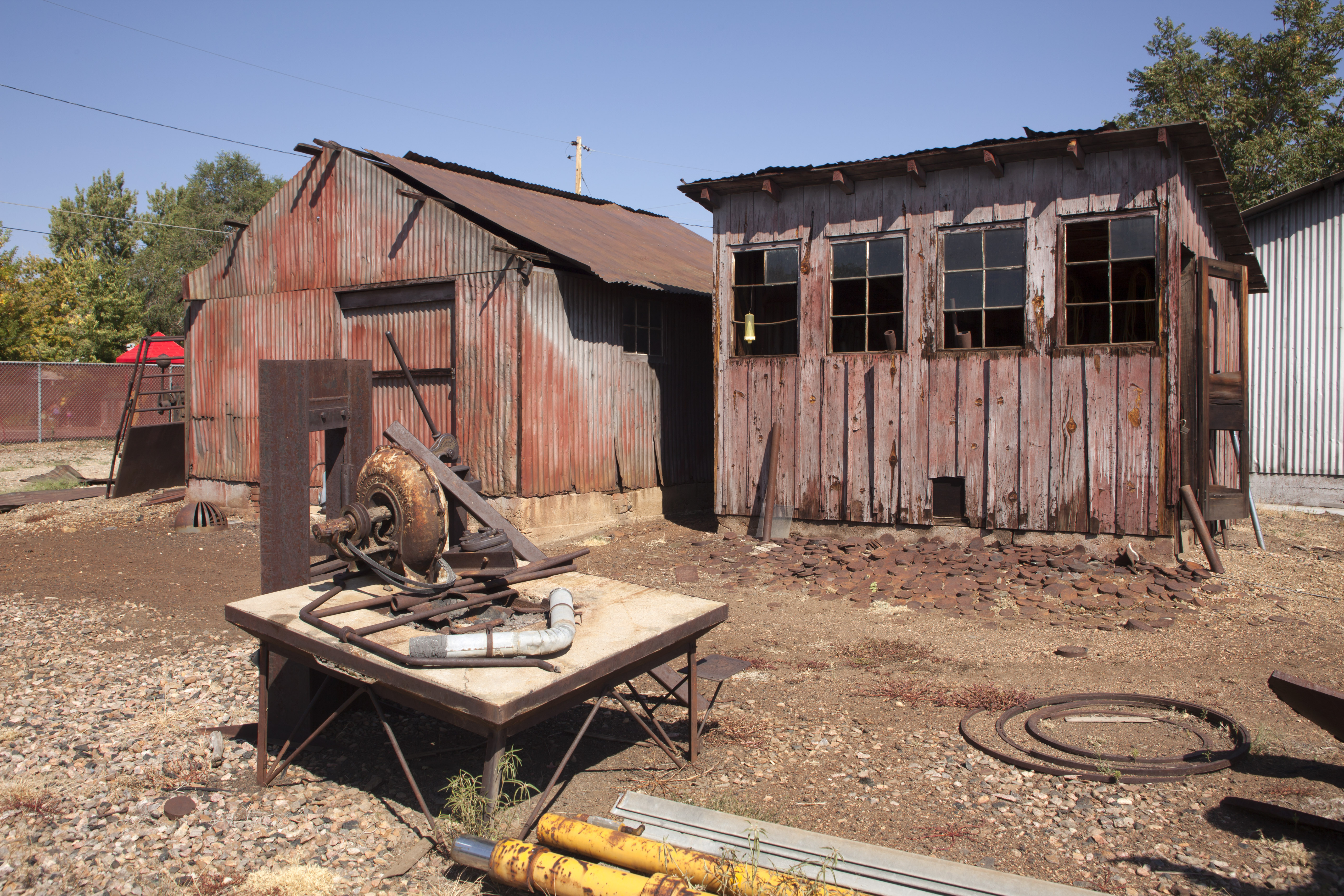
A circular blower for a blacksmithing forge sits on a table in front of the chicken coup and the corrugated metal shed. |
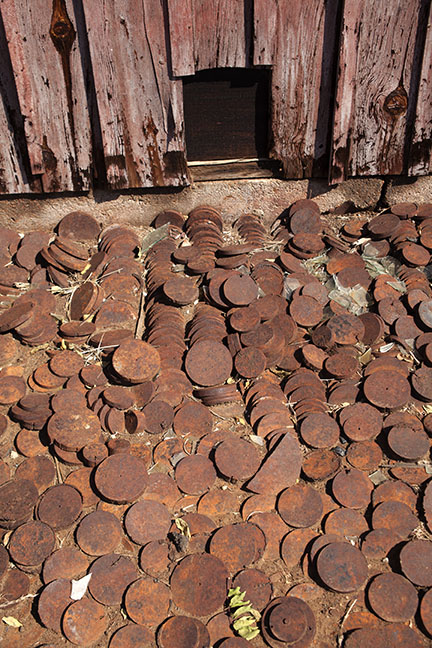 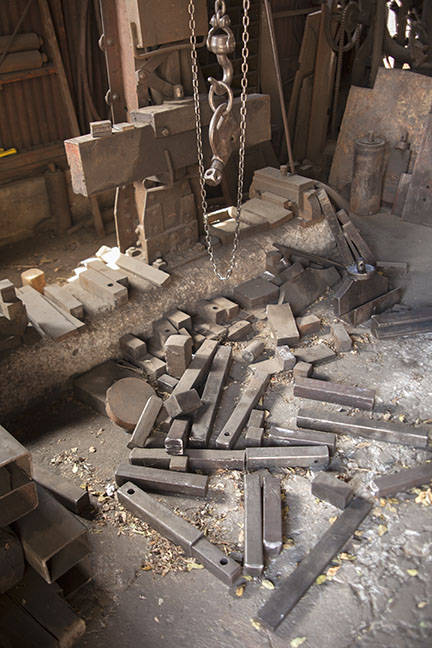
Like rusty, metal cookies, sliced cylinders of scrap metal remain in piles at the base of the chicken coup and rectangualar steel bars lie on the floor inside the metals building. |
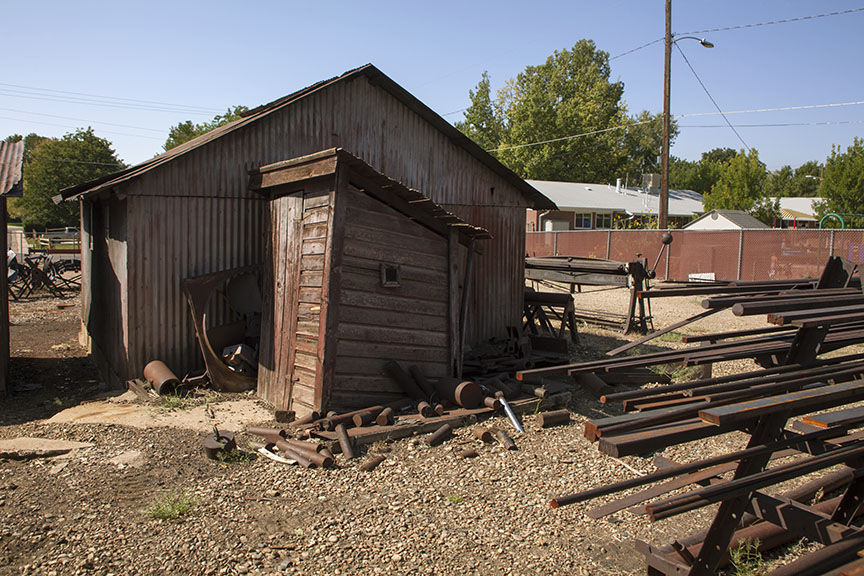
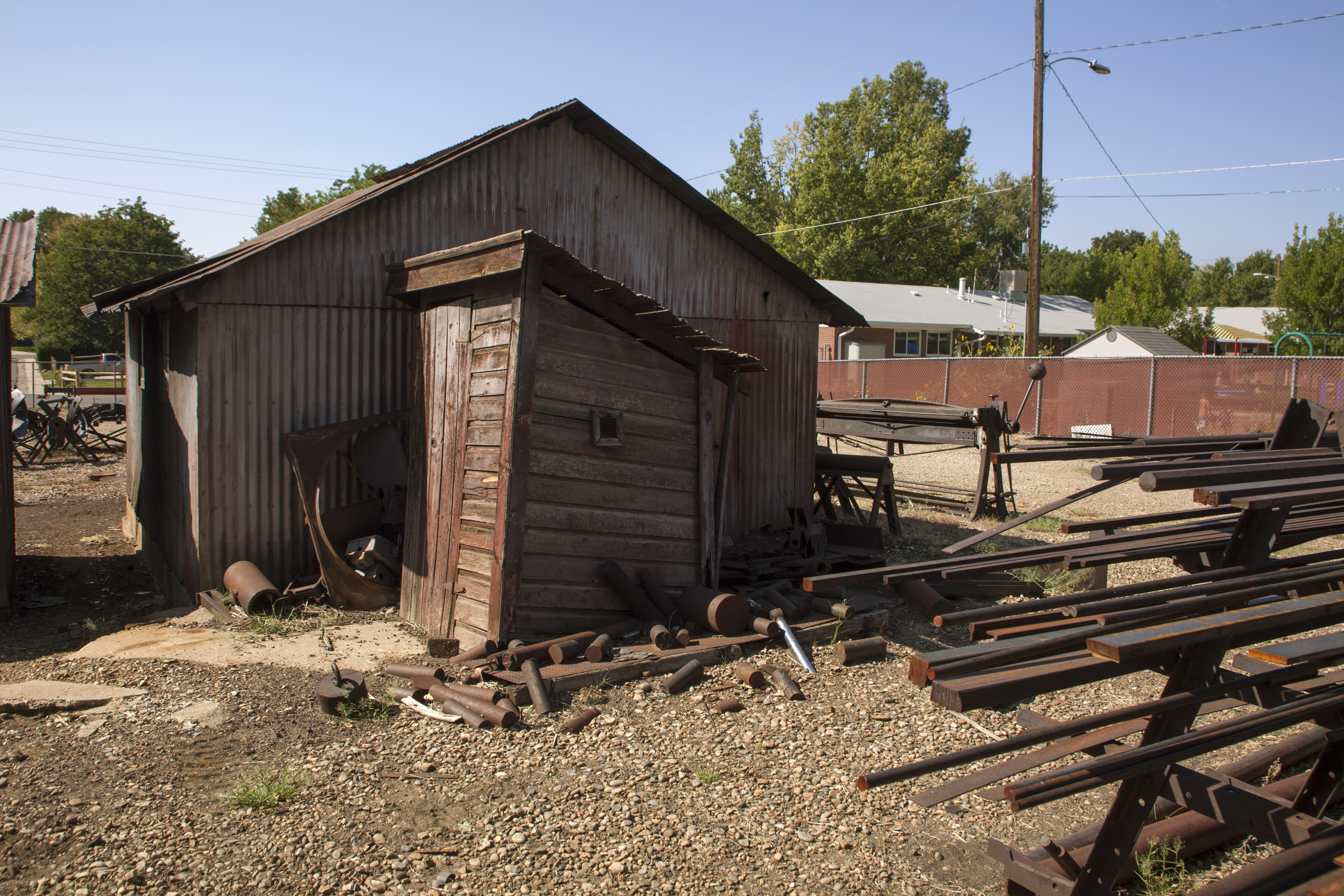
More scrap metal lies outside the leaning outhouse next to a shed and racks of long metal dowels an rods. In the background stands an industrial sheet metal bending brake. |
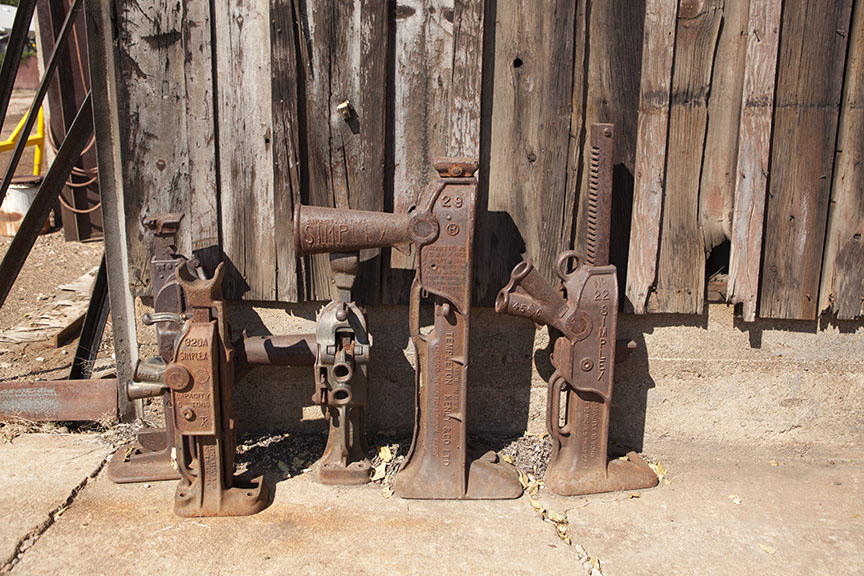
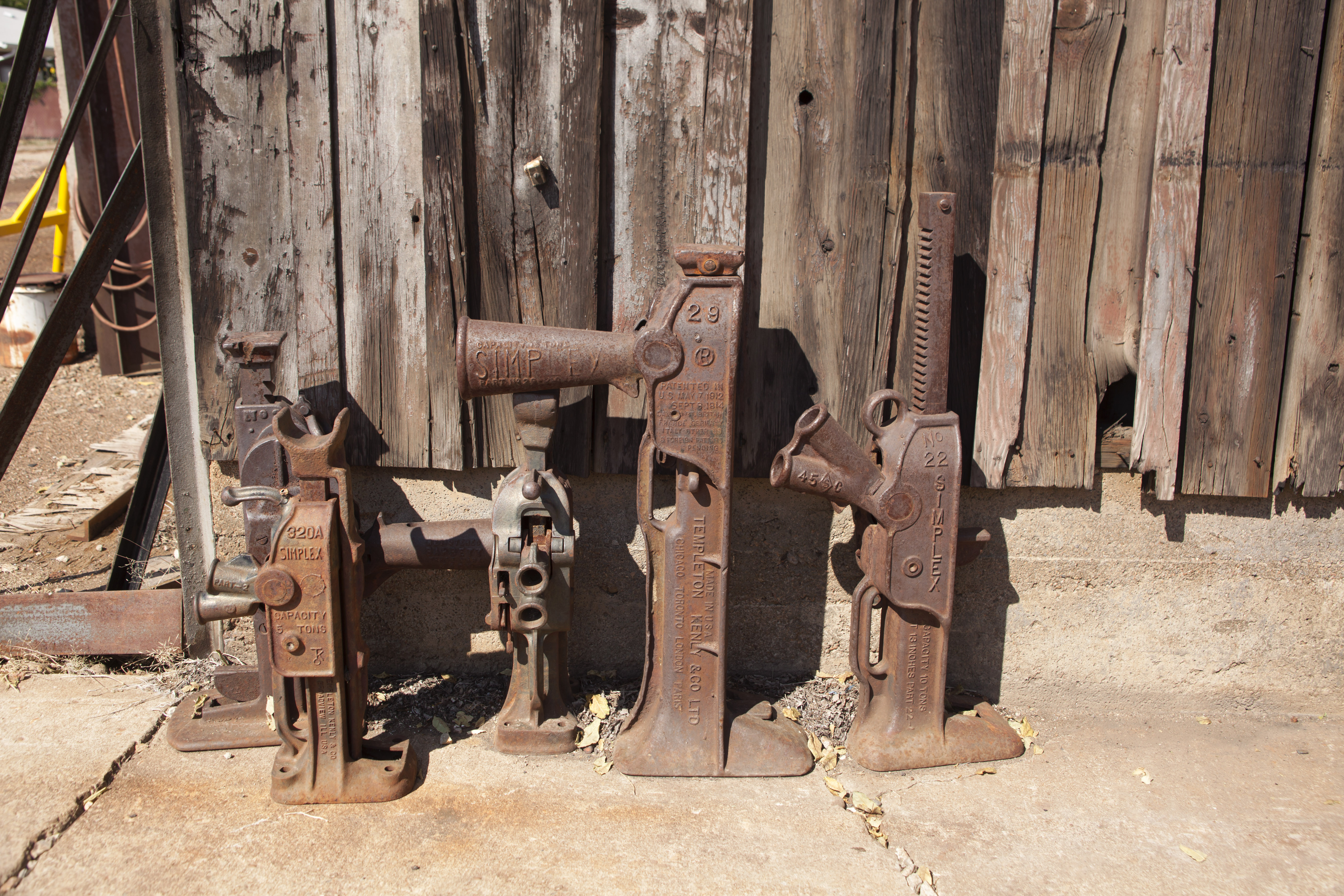
Standing next to the Welding building, early 1900s 5, 10, and 15 ton Simplex jacks made by Templeton Kenley and Company were commonly used in the railroad industry for lifting railway cars and performing track maintenance. A Barrett jack standing behind the Simplex 15 ton was primarily designed for lifting heavy loads, especially in railroad applications lifting rail cars and trolleys. |
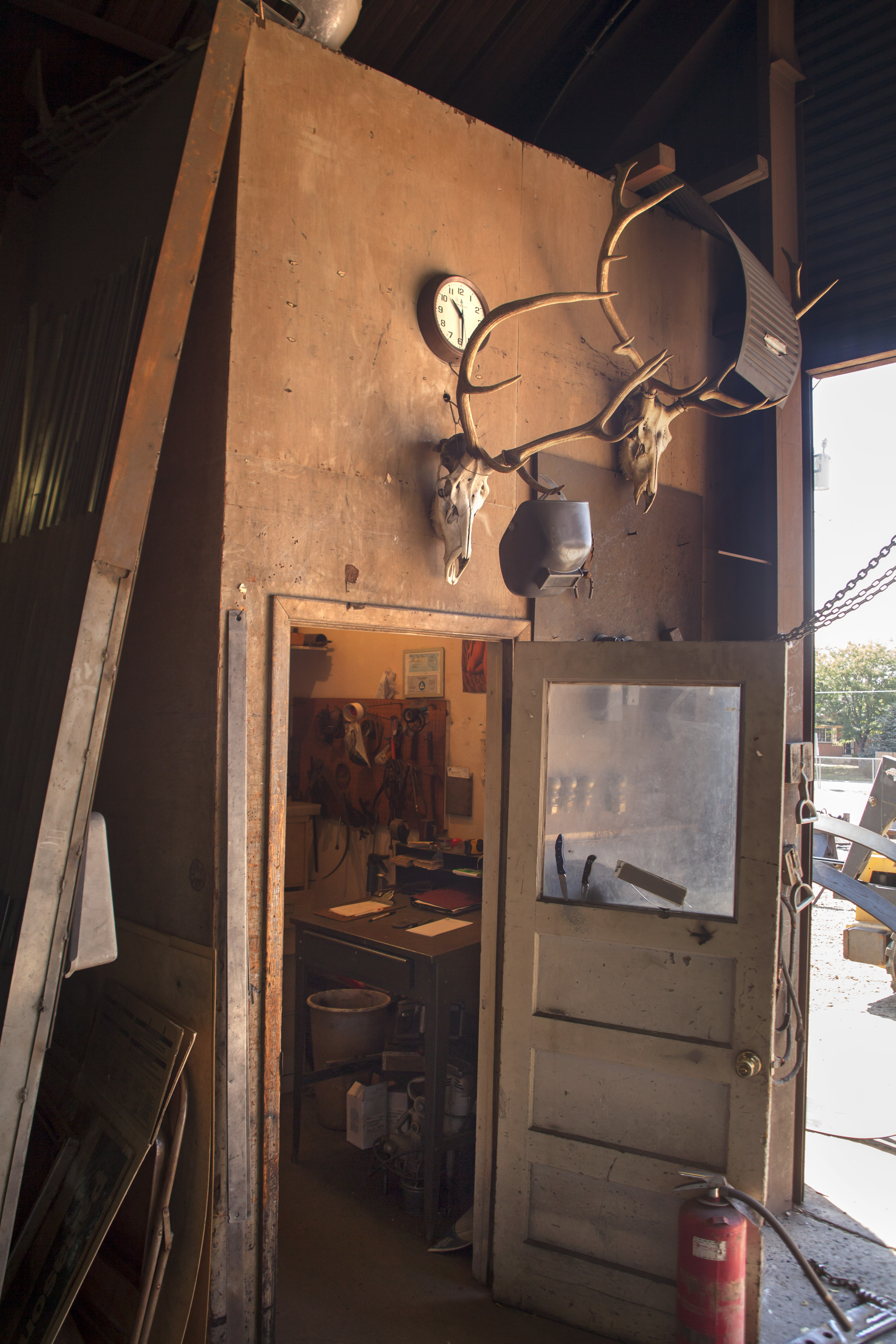
A welding mask/helmet dangles from an the elk antler perched over the office door proped open with a fire extinguisher. With pocket knifes wedged in the door frame window, the antlered skulls look out over the site office adjacent to the Welding building. An organized desk with paperwork sits under a pegboard of tools.
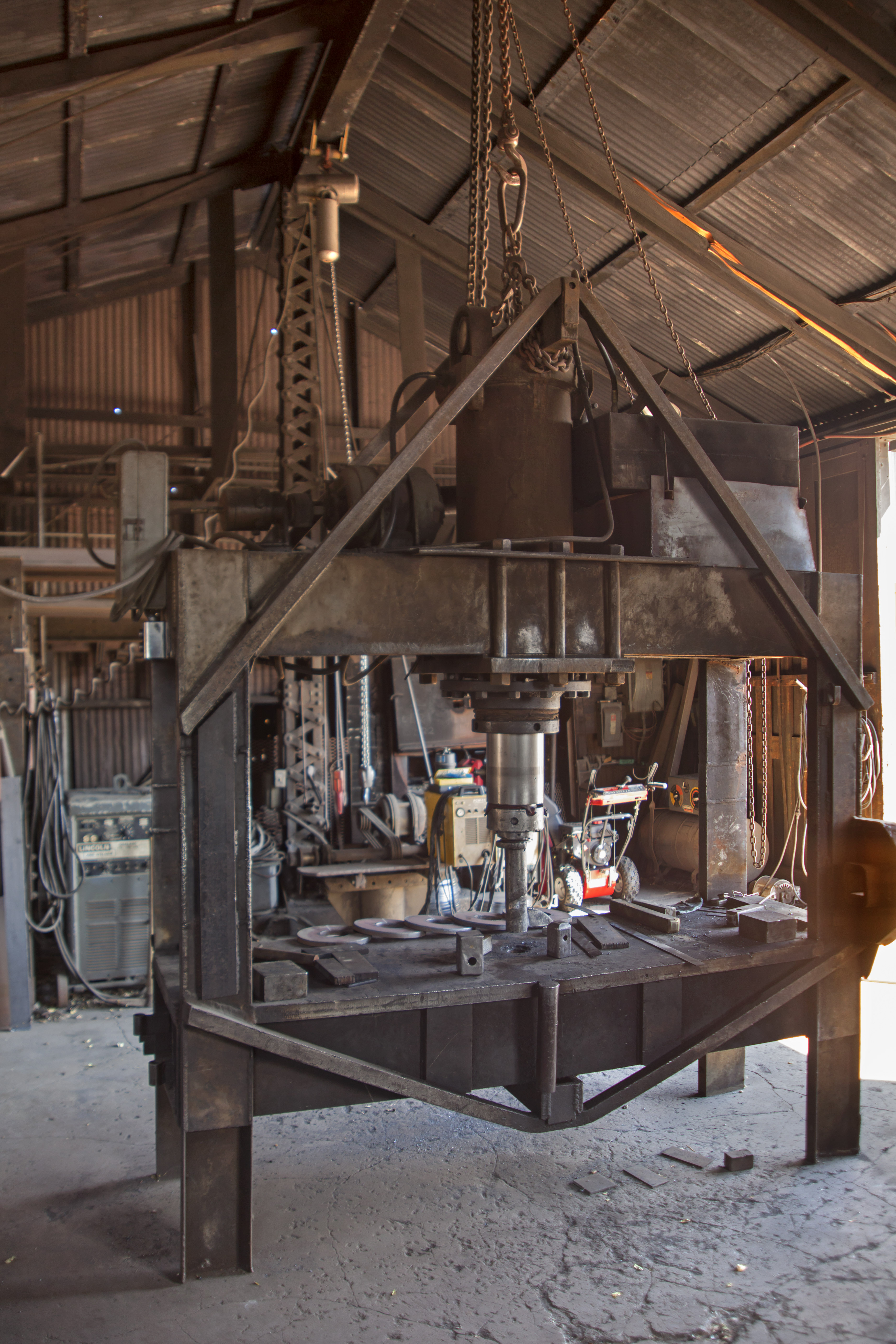
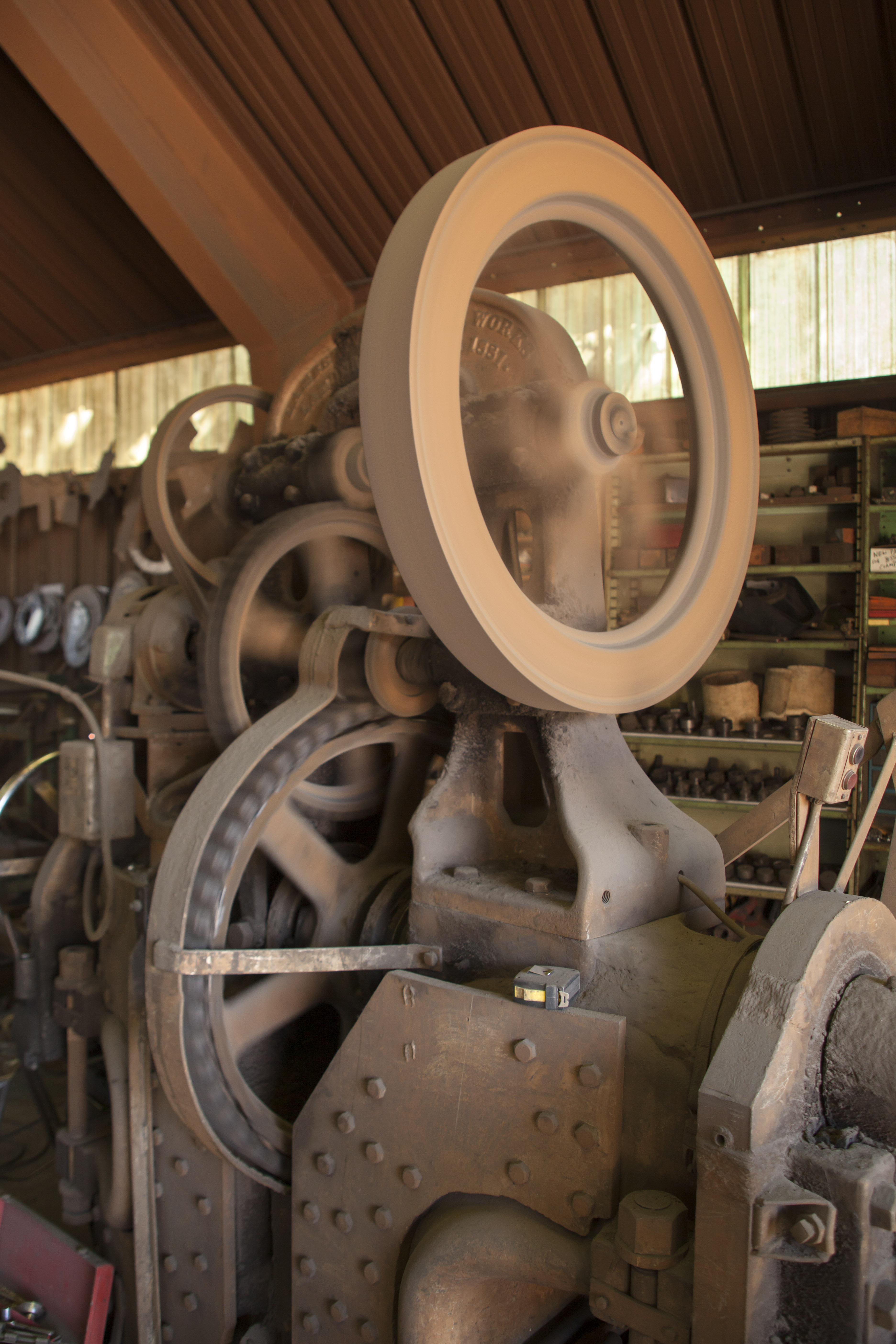
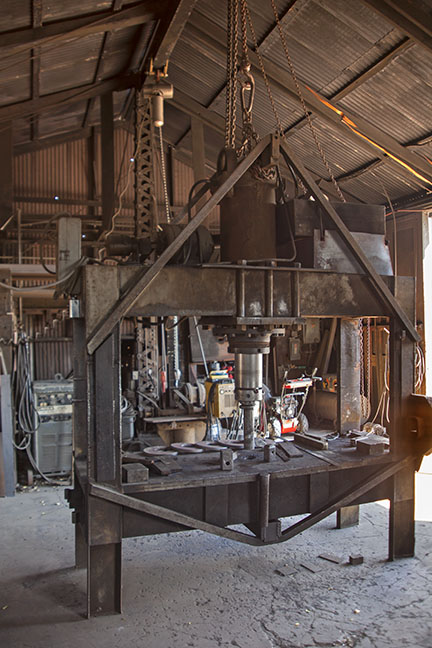
A large 250 ton press is used to manufacture flites or auger blades for drilling piers or caisson holes as well as straighten long shafts of bent steel. |

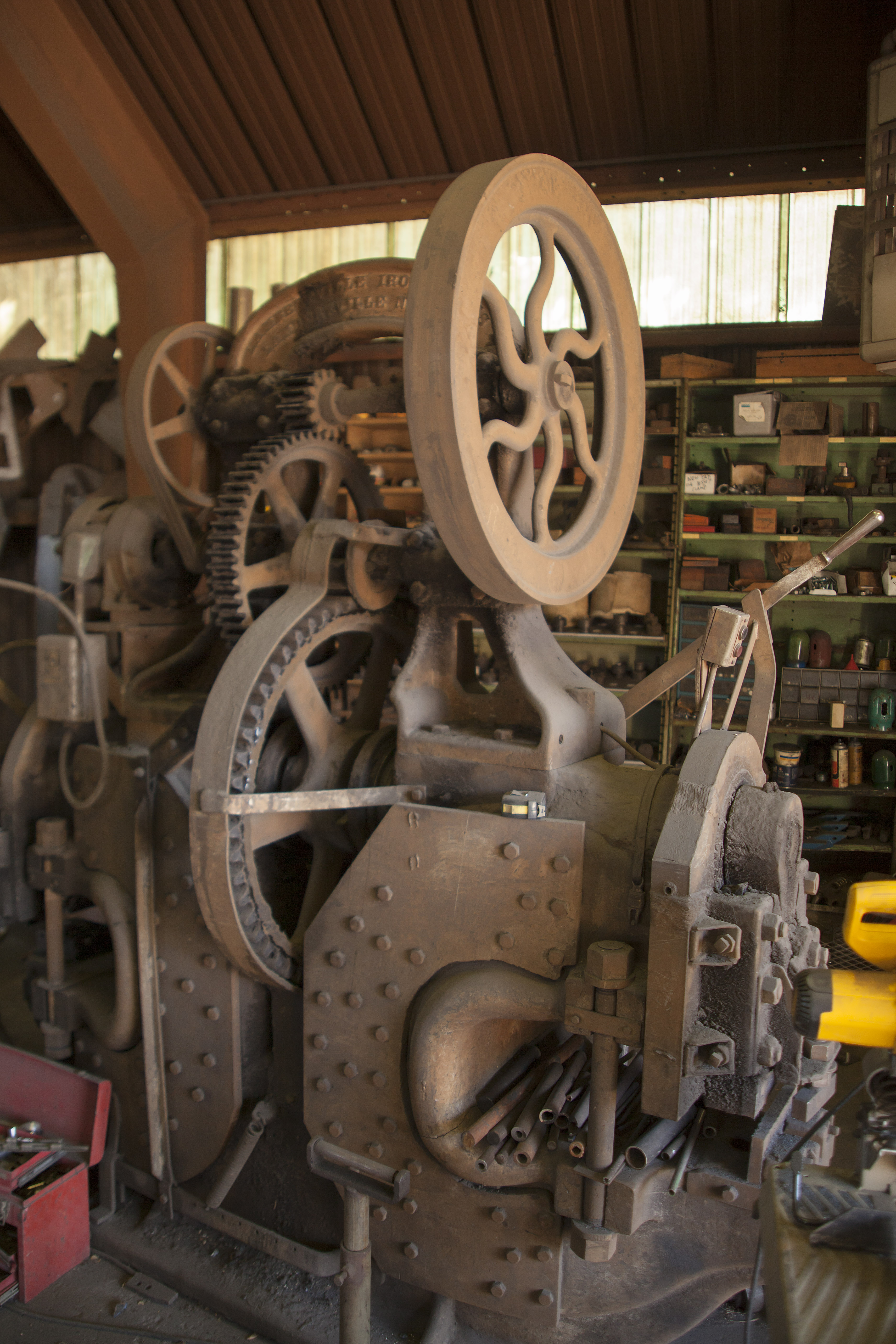
Standing in the corner, a welding stand sits ready for use next to wooden shelves housing small tools and metalworking materials with the 1881 built shearing/punching machine in front with support stands and a contemporary metal cutting saw. |
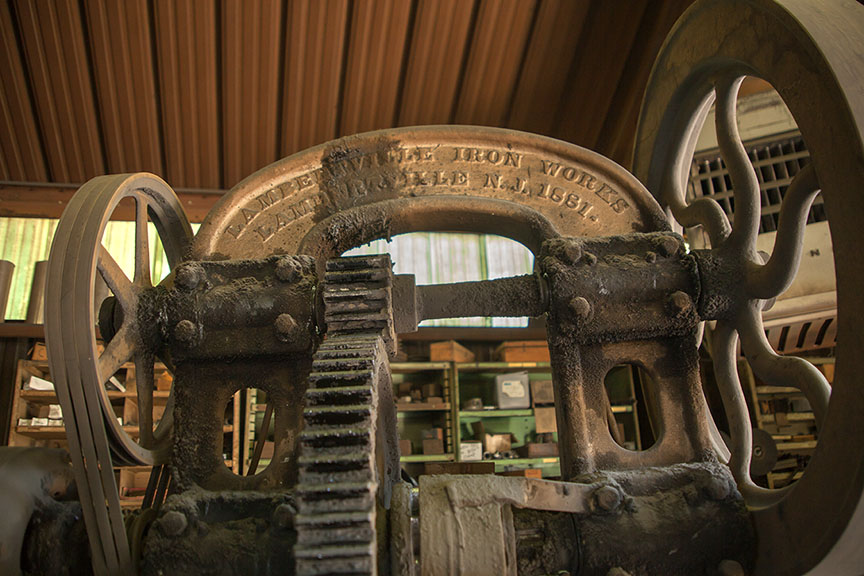
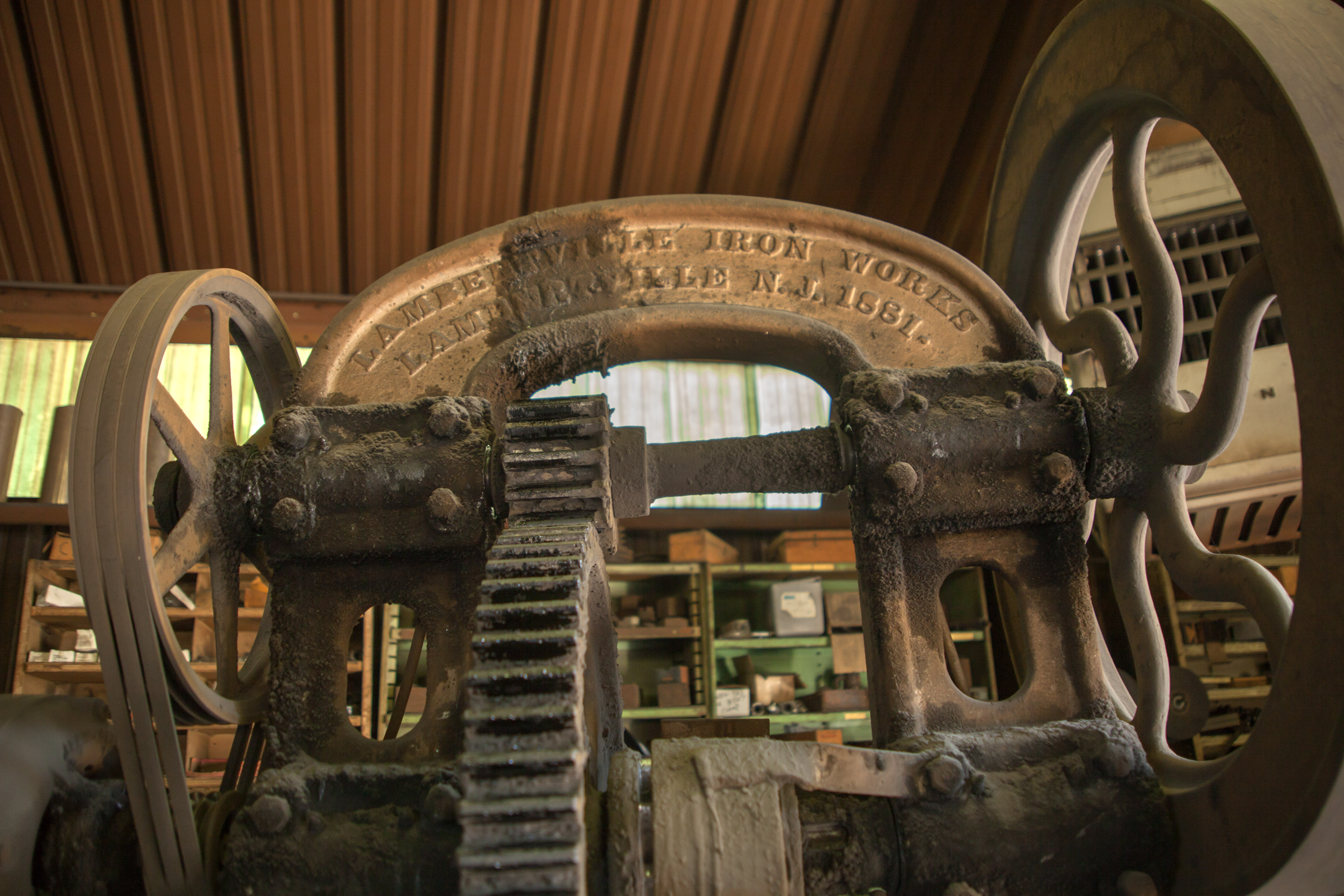
Metalworking machines like this shearing/punching machine manufactured in Lambertville Iron Works in 1881 were primarily used to produce various metal parts, including axles, steam engines, and safety boilers. Originally belt driven by a steam engine, the machine was converted to run on electricity. The machine stands seven feet tall and has a shear at one end and a punch at the other. It is able to cut three-quarter inch steel four inches wide and punch or pierce one inch holes in three quarter inch steel. |
 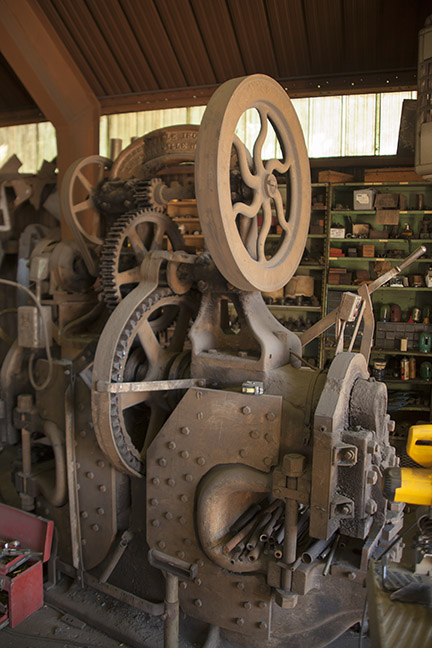
Still spinning since 1881, the antique shearing / punching machine evokes en earlier steam powered age. An electric motor now turns the gears, leaving the main belt driven wheel, once powered by a steam engine to spin freely. |
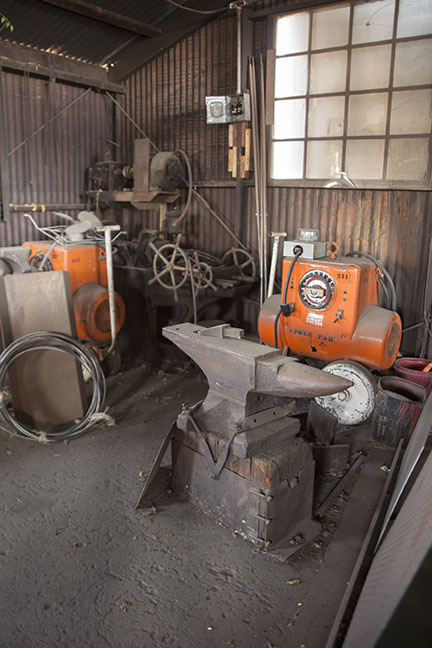
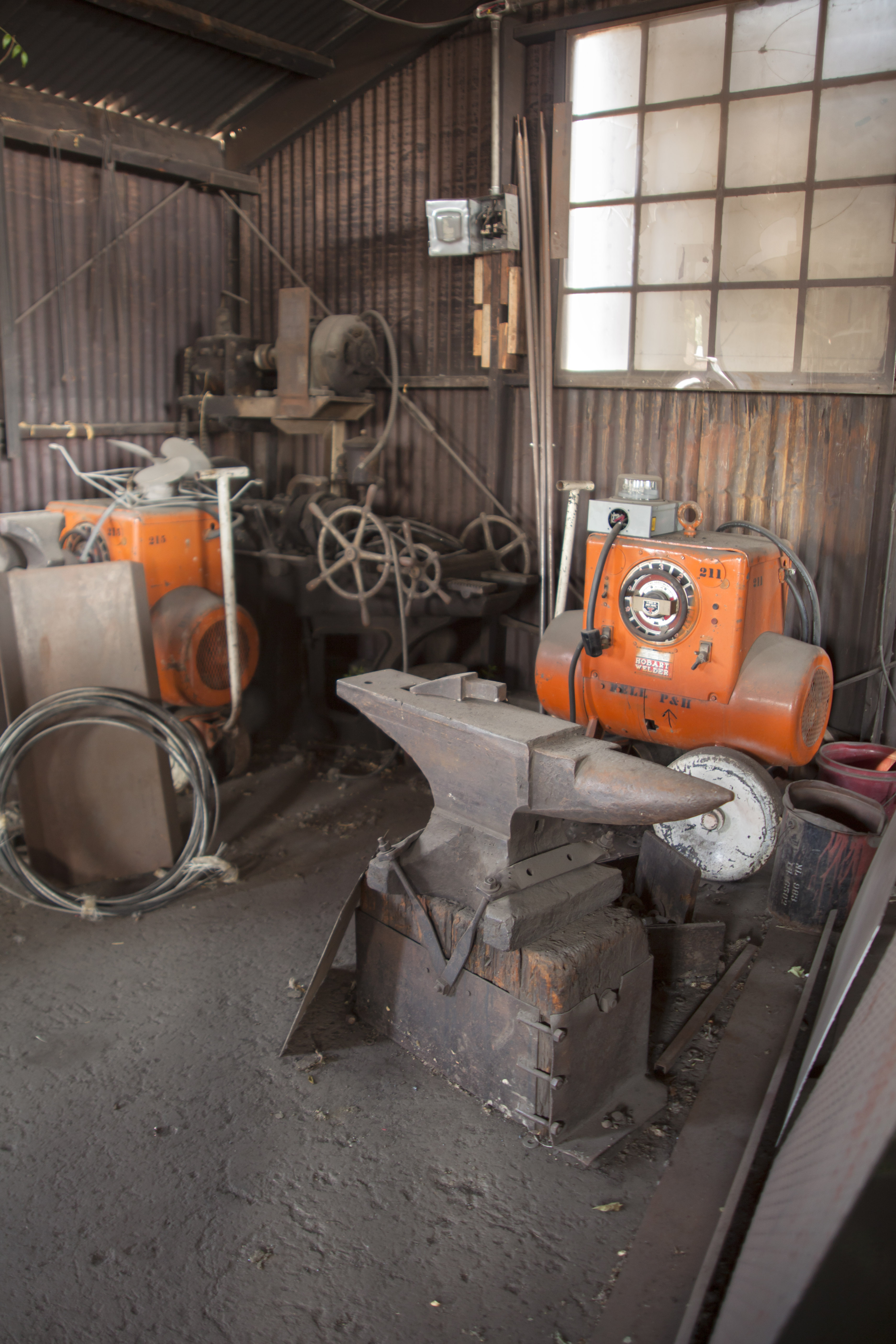
Also harkening back to the days of horse driven wagons and carriages, an industrial sized anvil remains mounted on a wooden blocks and bolted to the floor in front of welding machines and an old metals lathe manufactured by David W. Pond of Worcester, Massachusetts. |
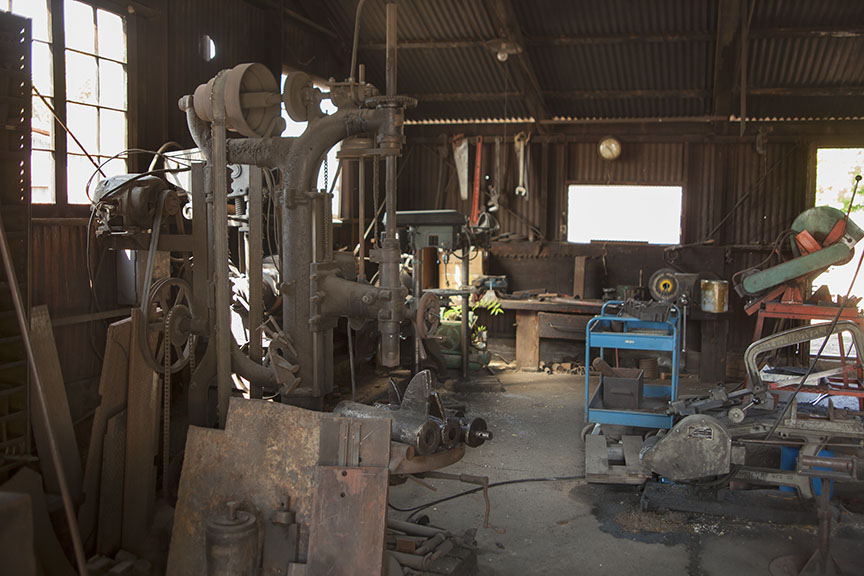
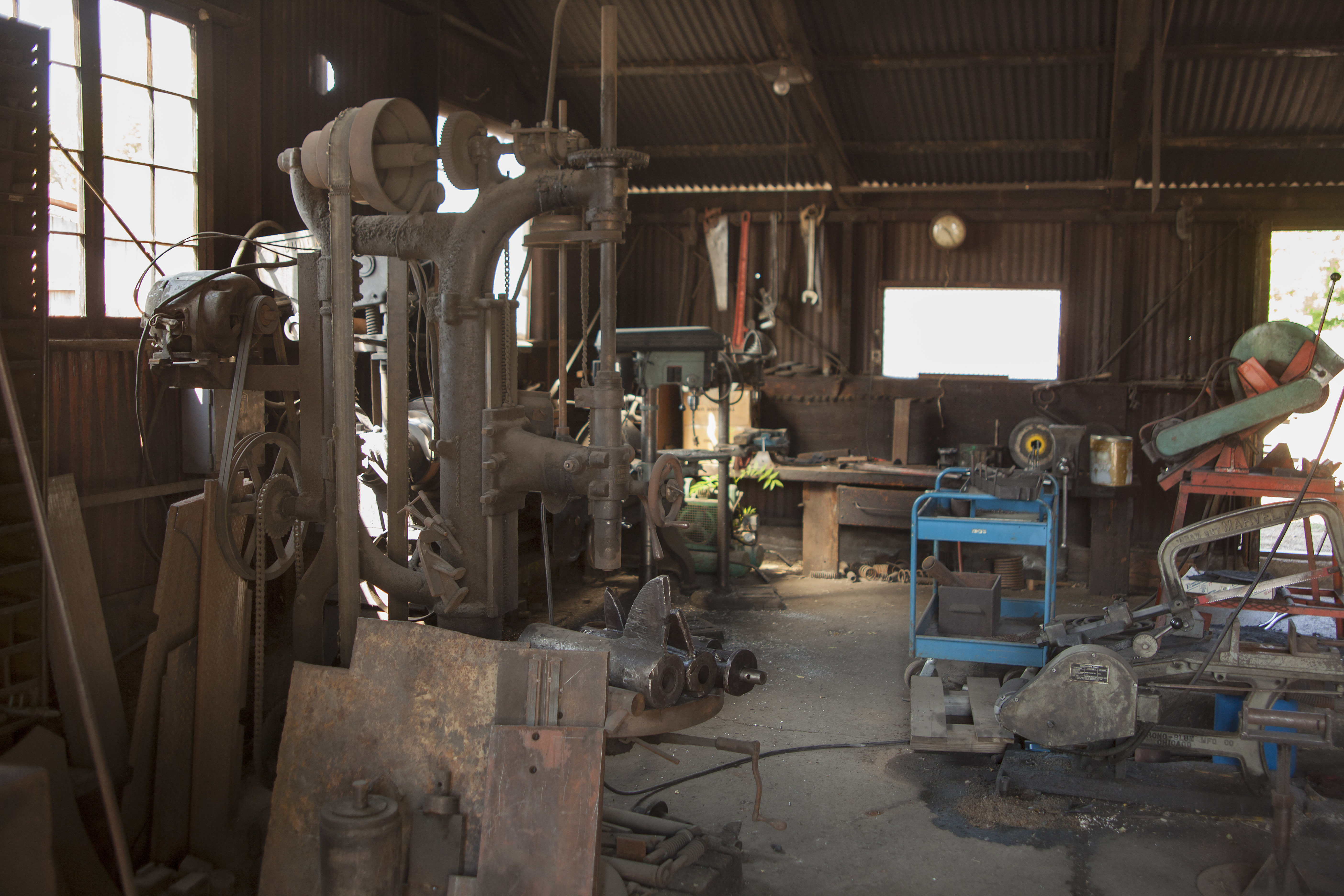
Another antique belt driven drill press stands tall near a smaller, more modern drill press hidden among various saws and equipment which cover the garage floor as wrenches, a hand saw and tools hang from on the wall. |
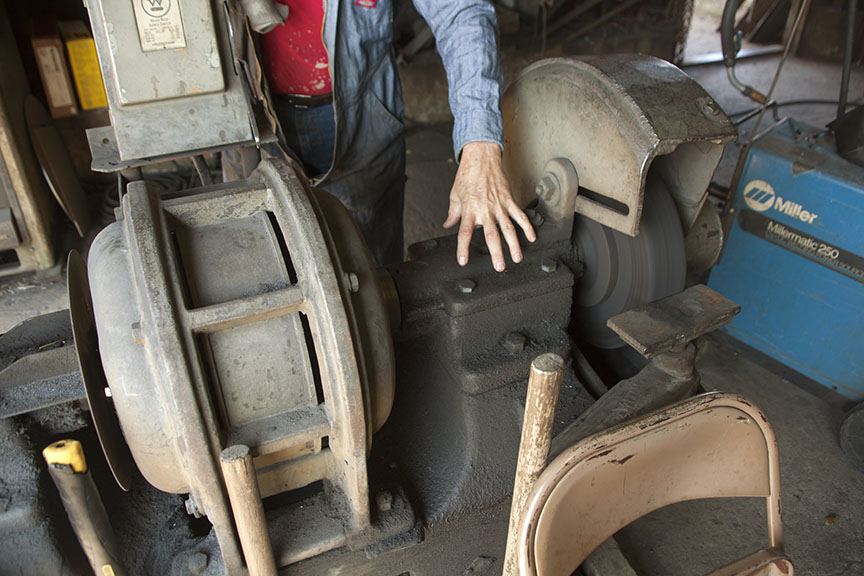
Built in 1913, a large bench grinder has wheels up to 24 inches in diameter. It's original cost was $75, however, today each grinding wheel would be well over $600.00 for just a 14 inch diameter wheel. |
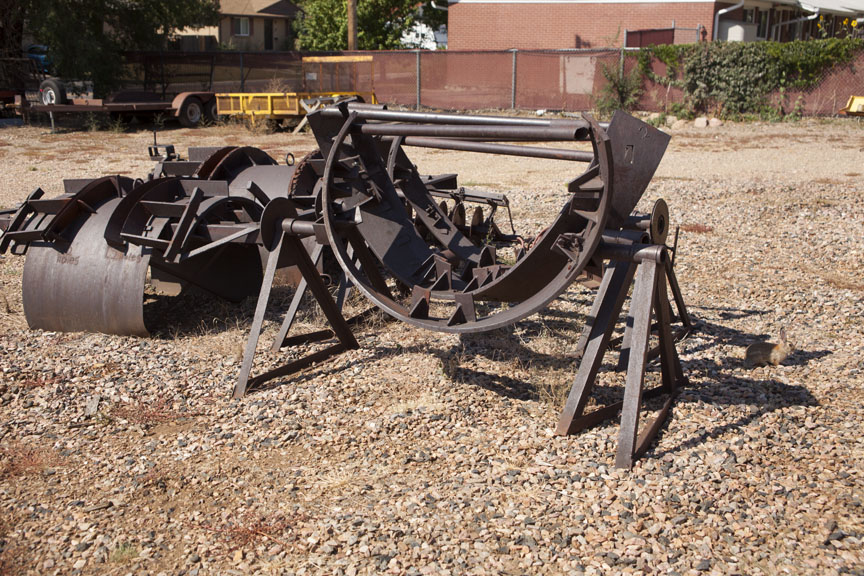
Out in the yard, a cottontail rabbit stands next to intricate and curved steel parts manufactured at Gorrell Iron works.
|
Gorrell 1925 Built Home, Lakewood, Colorado
Photographed in April, 2005
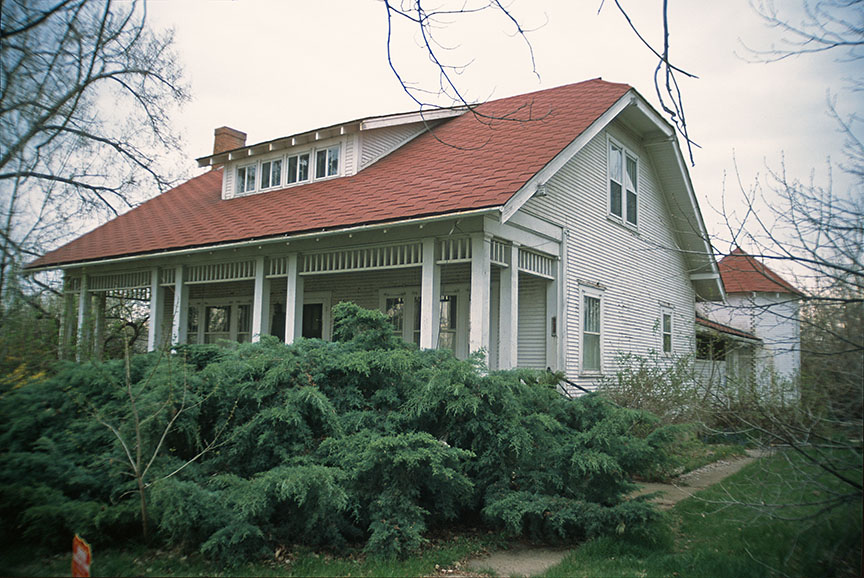
William Thomas Gorrell, arrived in Colorado from his native Ohio in 1881 and built a two-story farmhouse and some outbuildings. In 1924, a night time fire burning through the second floor woke the family. "They escaped safely, but not before the diminutive Mrs. Gorrell saved some of the family possessions by throwing them from an upper porch. At great personal risk, she also rescued her parlor furniture from the blazing structure. Gorrell and son Fred built a new brick home on the old foundation in 1925, and the original living room furniture remains today."
Description from Lakewood Colorado, An Illustrated Biography
WILLIAM THOMAS GORRELL FAMILY
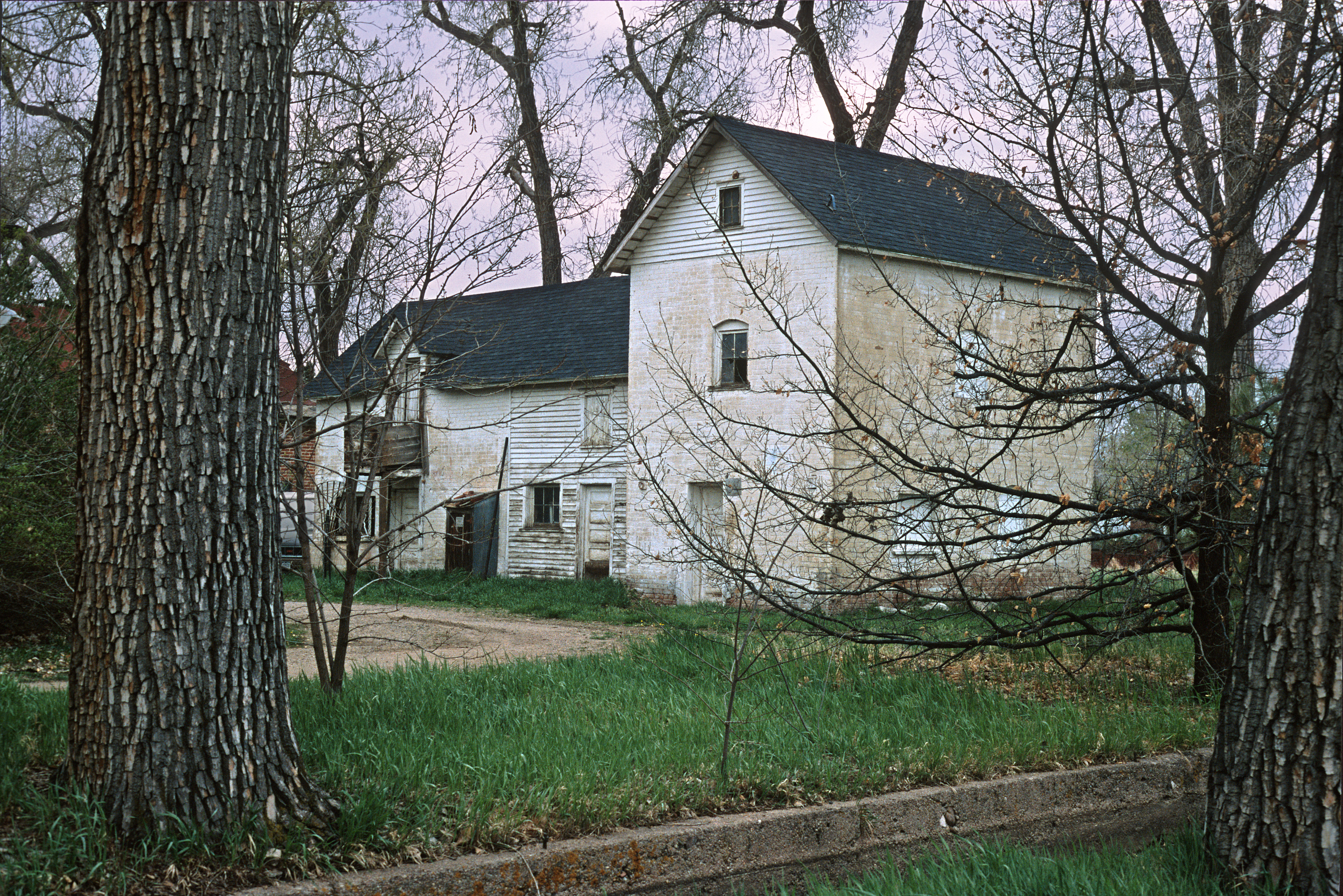
"Close to the West Mississippi Avenue roadway at the brow of the hill that slips down to South Garrison Street, a tall brick barn stands proudly surveying a sea of homes and gardens that have become its neighbors in recent decades.
The aging structure is one of a dwindling number of reminders of Lakewood's distant rural past. It was built in 1890 by William Thomas Gorrell, who had arrived in Colorado from his native Ohio in 1881. After nine years working for a land owner named A.R. Ayers, building fences and completing other jobs, Gorrell bought the first piece of land that, by 1906, totaled 320 acres, reaching west to today's South Garrison Street, east to Wadsworth Boulevard, and south to West Florida Avenue. In those days the streets, actually lanes, bore different names or were non-existent.
The 1890 purchase was quickly followed by construction of a two-story farmhouse and some outbuildings. Two years later, in 1892, Gorrell returned to Ohio where he married Anna Aduddell.
The couple set up housekeeping in the new house establishing a long residence that continues today. It remains home to Nora Gorrell Luino, and a grandson, Norman Nicholas.
The Gorrell dairy farm became prosperous through endless days and years of hard work. The big barn sheltered 30 milking cows and the usual array of other farm animals. Grains and corn grew in the fields and were stored in Gorrell silos to feed the stock. The Agricultural Ditch, flowing past the farmland at twice the level it reaches today, provided irrigation. Gorrell sold cattle and also rented property on Green Mountain as pasture for dry cows.
Anna Gorrell, a petite woman, bore a family of 13 children from 1892 to 1910. Five died in infancy. Elton was the oldest and Eleanor "Nora" the youngest. As youngsters they attended the Bancroft School when it was a small frame building. It was replaced by a two-story brick structure. Between Elton and Eleanor were Fred, Mary, Bob, Nellie, Jim and Everett. Nellie also attended the first year of Bear Creek Consolidated School in 1920.
One night in 1924 the sleeping family was awakened by Everett, whose slumber was broken by flames licking at his second floor bedroom wall. All escaped safely, but not before the diminutive Mrs. Gorrell saved some of the family possessions by throwing them from an upper porch. At great personal risk, she also rescued her parlor furniture from the blazing structure. Gorrell and son Fred built a new brick home on the old foundation in 1925, and the original living room furniture remains today. A visitor stepping into the place in 1993 is transported back to the early 1900s.
Nellie Gorrell thinks that her father should have had a meat packing place, for he was a skilled butcher. The smokehouse at the rear of the home was always filled with cured hams and sides of beef for the large family's use. In spring time some 24 hired hands helped with the heavy work, and lived in a two-story bunkhouse with some of the Gorrell sons. The old cookstove that still stands in the big kitchen was in constant use as meals were prepared for the two dozen helpers as well as family members; at least 12 people were at the table for every meal.
The ground floor of the bunkhouse was the wash room for the big milk cans. Next to it was a tank building for milk storage, and the only good well on the property provided water for milk cooling. The Gorrells also cut ice from their two ponds to keep milk fresh and cold.
Nellie Gorrell Green recalls that neighbors bought milk for 10 cents a gallon. As years went on, the Gorrells helped found the Hall Dairy herd and sold wholesale to the Alderfer Dairy, Windsor Dairy and Carlson Frink Dairy.
Electricity was installed in the 1940s, but until that time the house was lit by their Delco plant, with batteries and a charging generator providing 32 volts for lights and radio.
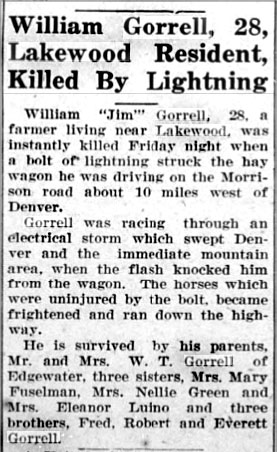
Tragedy struck again in 1935 when Jim Gorrell, working in the fields near South Garrison Street, was killed by a bolt of lightning. It was his brother Bob's sad task to take a wagon to the scene and return the body to the family home. Nellie and Nora recall that Jim's shoes were blown off his feet and buckles of his overalls were deeply scorched into his skin.
Eventually, William Gorrell gave each of his children six acres of land for their homesites, dictating exactly how each should be built. Elton and Fred constructed Elton's house on South Garrison Street. Fred built at the east end of the acreage where he had his home and Gorrell's Iron Works, a blacksmith and repair shop. Bob and Everett Gorrell stayed in the dairy business until after World War II. In the mid-1950s they sold a large part of the old farm to developers of the Palomino and Greenwood Park subdivisions. The dairy itself, its equipment and herds, were sold in the 1960s. Elton died in 1943, Bob died in 1972, Warren in 1977, Fred in 1978, and Everett, who remained a bachelor, died in 1985.
Mary Gorrell married Bill Fieselman. Their home was west of the present bowling lanes on West Mississippi Avenue. They had seven children, one of whom drowned in the Agricultural Ditch nearby. Nellie married Warren Green, one of the Green brothers famous locally for their harvesting and drilling equipment. Their original house stood on the present site of Alameda Senior High School. The R-1 Board of Education bought their land in 1957 and the Greens built a new home on West Mississippi Avenue, where Nellie still resides. The Greens had one daughter, now deceased. Nora married Frank Luino of the Luino-Grosso family of the Alameda area, living for a short time at West First Avenue and Pierce Street. They had a daughter. Luino died early of blood poisoning and Nora returned to the old family home.
The older Gorrells who had pioneered here have long been dead; Mother Anna died in 1937 at age 71 and William at age 83 in 1940.
For the entire Gorrell family, farm life was unending hard work, but theirs was a model establishment. Tragedy surely took its toll, but life offered many rewards. With more than 100 years' occupancy on the original 1890 property, the Gorrells are truly a Lakewood family!"
|
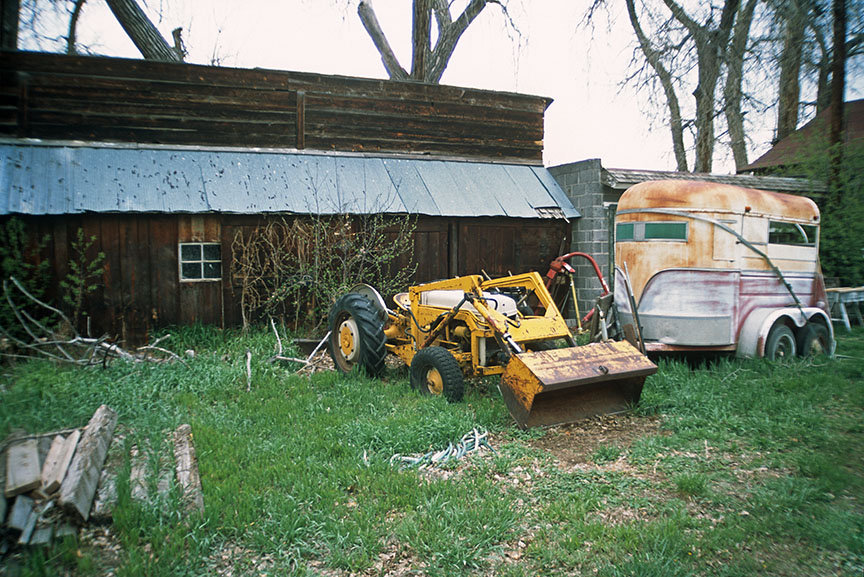
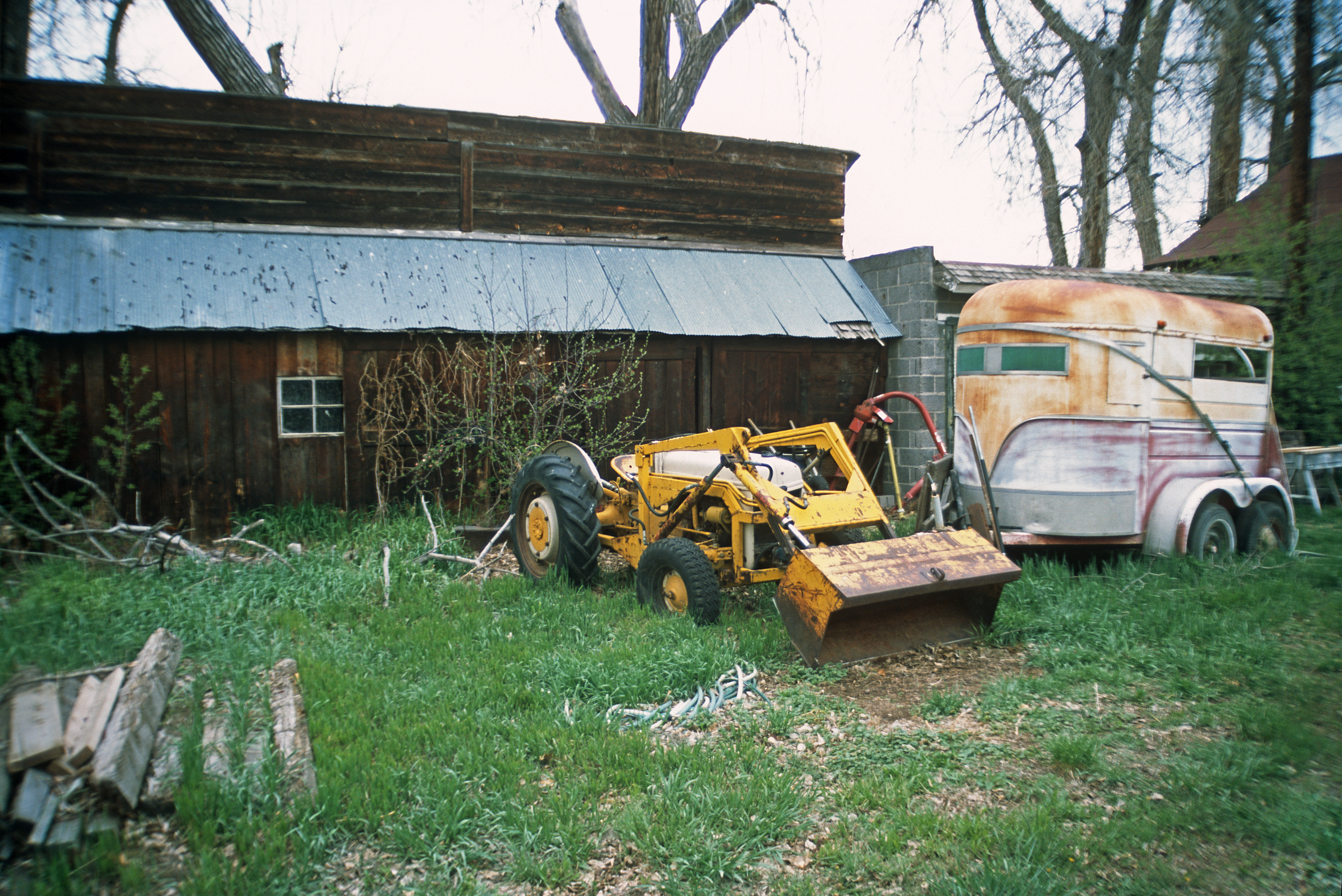
An old front-end loader stands in the grass next to a vintage horse trailer and outbuildings on the Gorrell farm. |
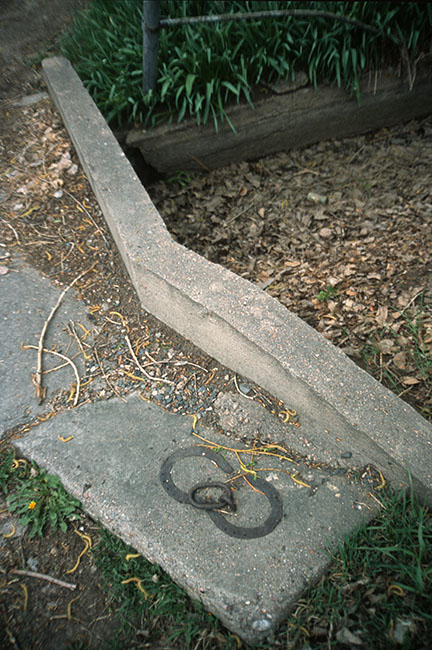
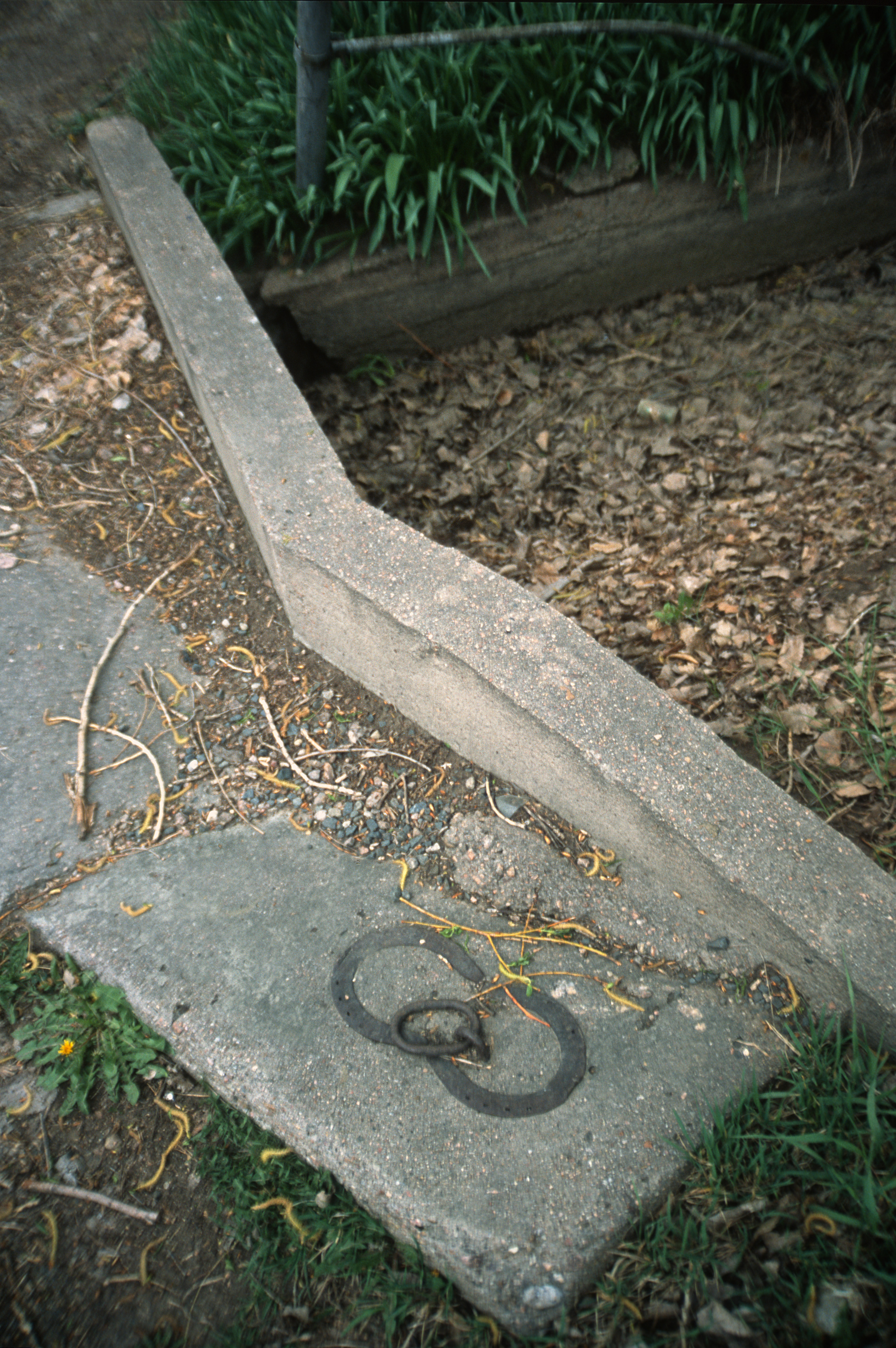
In between the home and bunk house and sunk into a cement block, a pair of horseshoes surround a loose chain link, perhaps at one time, convenient for parking the horse or for looping a horse lead for grooming or cleaning the hooves. |
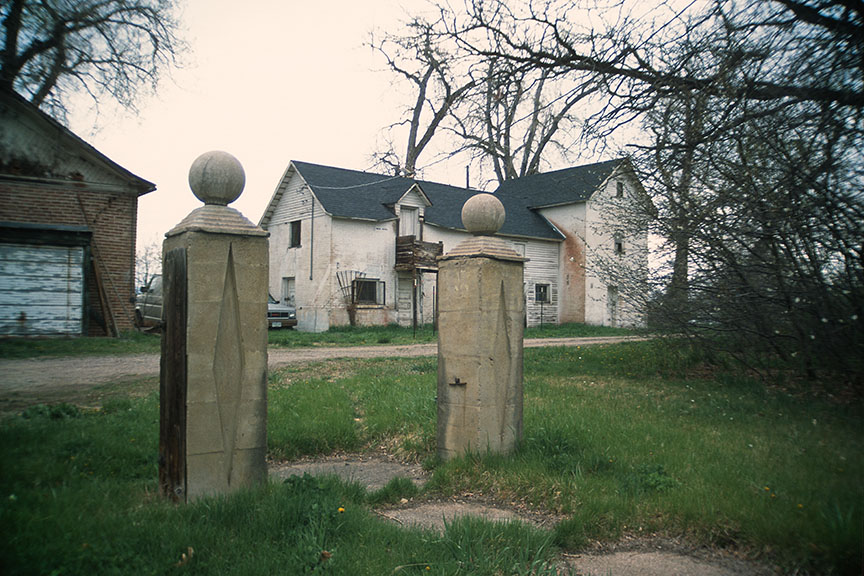
Twin cement pillars guard the walkway entrance to the side of the house. The bunkhouse with attached milk house on the far right stand in the background. |
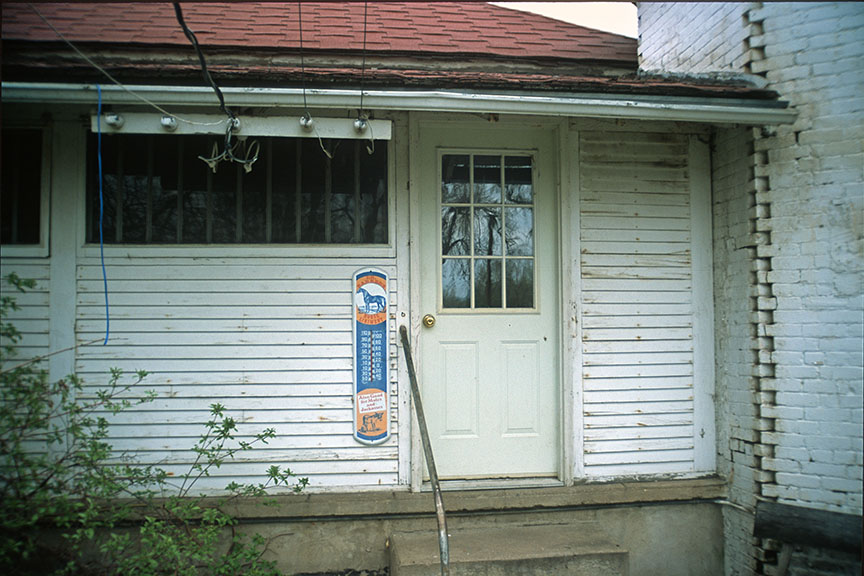
A large, "Dr. Barkers Horse Liniment - Also Good for Mules and Jackasses" thermometer remains on the side of the house near the power lines and brick smokehouse.
|
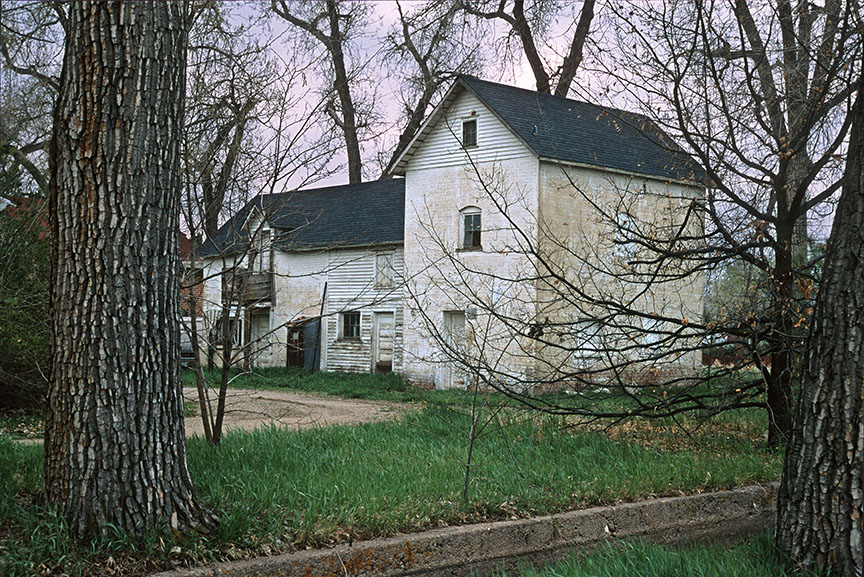
The milk house, built in 1890 and standing tall also had a well for the family's water supply which also cooled the nearby milk tank. The bunk house on the left had a milk can storage area on the ground floor, with sleeping quarters upstairs. An outside set of stairs, now missing would have led to the
wooden landing pictured awkwardly protruding from the second story doorway. |
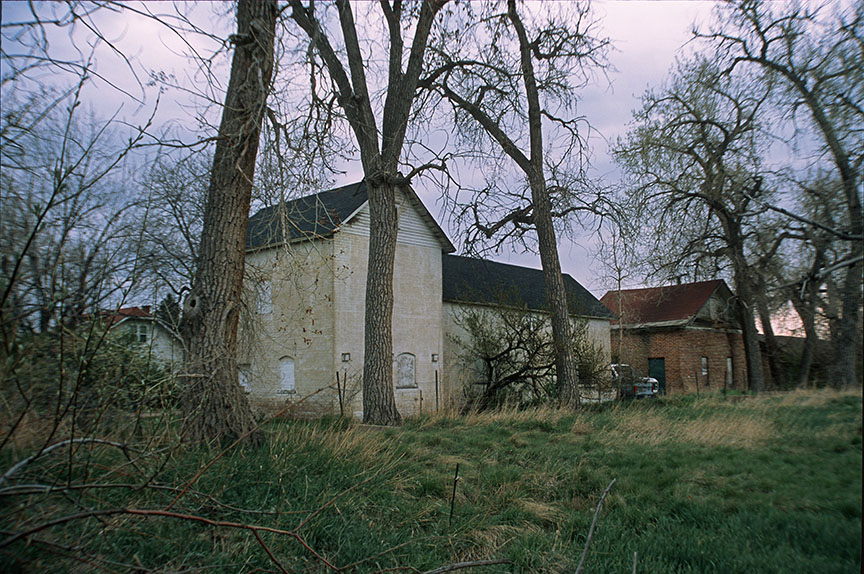
Looking from near the sidewalk, the rear of the brick constructed milk house, bunk house and garage. The bunk house provided living quarters for about two dozen men who were employed by the Gorrells during the spring growing season on the 320 acre dairy farm. The family sold their milk to daries for processing and retail sales. Alderfer Dairy, Windsor Dairy, and Carlson Frink Dairy all bought Gorrell milk. In the winter, the Gorrells supplemented their income by cutting and delivering ice from the two ponds on their property. |
DP Home | Feature | Gallery | About
|